Beetles (order Coleoptera, infraclass Neoptera, subclass
Pterygota, class Insecta, subphylum Hexapoda, phylum Arthropoda, kingdom Animalia)
Beetles are the largest insect order; over 350,000 species of
beetles have been documented. This means that about a third of all known
animal species are beetle species. A very large proportion of them,
in turn, are "leaf beetles," those in the Chrysomeloidea superfamily,
and a very large proportion of those are in the Chrysomelidae family.
Beetles have "sheathed" wings: their forewings have
become protective shells, called "elytra," for their membranous hind wings,
which actually do the flying. This is only one of fourteen identifying
characteristics of beetles, but one of the two earliest characteristics to
appear: beetles have had elytra for the past 285 million years. Their hind
wings, made of membrane and which are folded up under the elytra, are a later
development (245 million years ago), at least for the 90% of beetle species in
the suborder Polyphaga (Grimaldi & Engel,
2005, p. 361). Their hind wings are much bigger than their elytra
forewings, sometimes sticking out from under these covers when flying beetles
land. Do they have trouble folding up their big hind wings? Some
Soldier Beetles do, apparently!
Beetles undergo complete metamorphosis, i.e., they experience
a pupa stage during which their anatomical structure changes dramatically. Unless stated otherwise, all taxonomic categories on
this page were checked for validity against the contents of the
Integrated Taxonomic Information System.
NOTE: All IDs on this page as tentative, as are IDs on every page of this website.
To produce a search box, type CTRL-F.
Lady Beetles (family Coccinellidae, superfamily Cucujoidea, infraorder Cucujiformia, suborder Polyphaga)
Almost all Ladybug Beetle species are carnivorous: all those that appear on this page are. However, it appears that they (as do many carnivorous species) also include flower nectar in their diets. Both Ladybug Beetle larvae and adults walk rapidly over the irregular surfaces where they are most often found; they are often seen charging up one side of a grass blade and down the other. They often, though not always, find their way to any aphids in the general area, and process them relatively slowly.
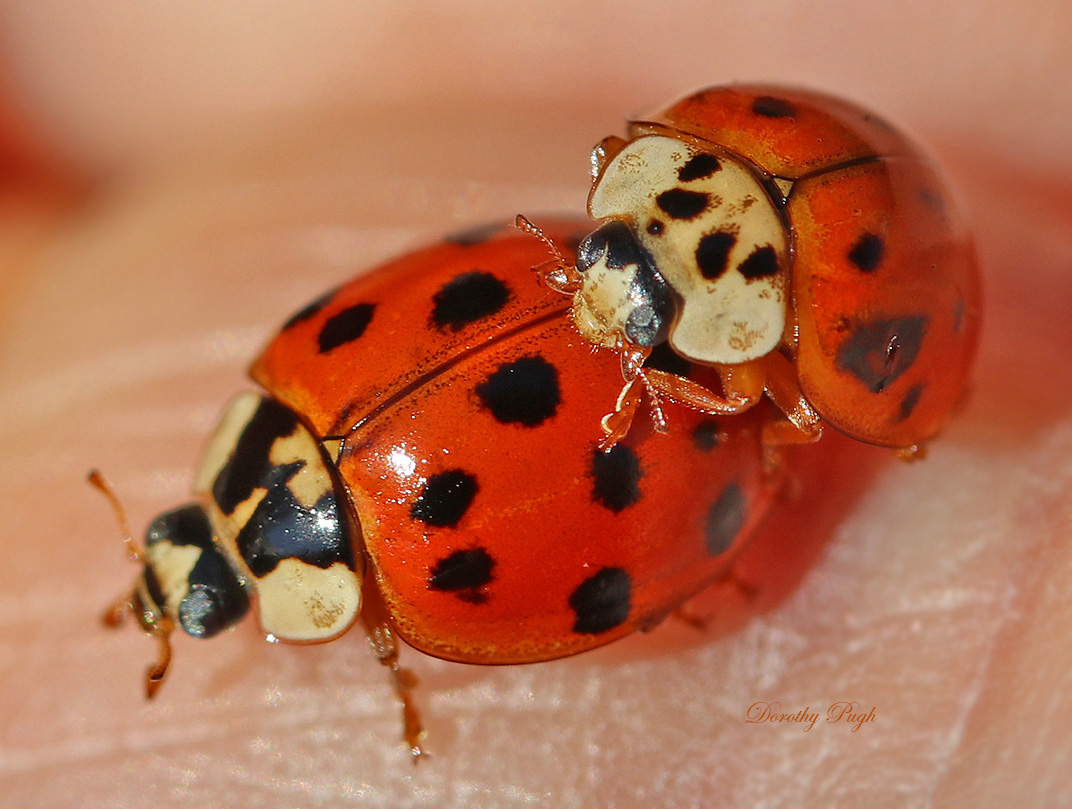
This shows different species of ladybugs that appeared in my part of the country (north-central North Carolina). The Multi-colored Asian Lady Beetle is very common and, as its English name suggests, shows a great deal of intra-species variation, not simply in color but in size of spots.
Multi-colored Asian Ladybug Beetles (Harmonia axyridis, subfamily Coccinellinae)
These beetles show a lot of variety in both color and spot patterns.
 |
 |
 |
 |
 |
 |
 |
 |
| Mating Asian Multi-colored Ladybug Beetles, Durham, NC, 9/13/16 | Asian Multi-colored Ladybug Beetle pair, Durham, NC, 11/17/20 | Asian Multi-colored Ladybug Beetle pair, Durham, NC, 9/25/21. Looks as though the one on top is female; confusion reigns! | Mating Asian Multi-colored Ladybug Beetles, American Tobacco Trail, Durham, NC, 7/26/09 | Asian Multi-colored Ladybug Beetle, Durham, NC, 4/2/08. | Durham, 5/3/05. Female Multi-colored Asian Ladybug (19-spot) Beetle. Unlike native ladybugs, they try to enter houses and become pests in the process. | Multi-colored Asian Ladybug Beetle, Durham, 9/9/05. | Multi-colored Asian Ladybug Beetle, Durham, 7/5/05 |
 |
 |
 |
 |
 |
 |
 |
 |
| Newly emerged Asian Multi-colored Lady Beetle and pupa shell, Durham, NC, 7/2/24 | Asian Multi-colored Ladybug Beetle, Durham, NC, 7/17/21 | Multi-colored Asian Ladybug Beetle, Durham, 7/13/06. | Durham, 11/4/05. This Multi-colored Asian ladybug quickly freed herself from this spider web by somehow causing the strand it was on to lengthen and weaken. | Asian Multi-colored Ladybug Beetle, with what's apparently a small insect on top. Durham, 6/21/08 | Freshly emerged Asian Multi-colored Ladybug Beetle, Durham, NC, 11/18/17. Interesting commentary about this, with Joel Kits' suggestion that this insect might be a representative of a (permanently) spotless variation of this species. | Asian Multi-colored Ladybug Beetle. No spots at all!, Durham, NC, 8/14/08 | Multi-colored Asian Ladybug Beetle, Southern Village, Orange County, NC, 11/13/07. The spots have just started to come out on this recent metamorph. |
 |
 |
 |
 |
 |
 |
 |
| Asian Multi-colored Ladybug Beetle with wing and elytra problem, Durham, NC, 12/30/21 | Same Asian Multi-colored Ladybug Beetle | Asian Multi-colored Lady Beetle, damaged, Durham, NC, 5/10/25 | Damaged Asian Multi-colored Ladybug Beetle, Third Fork Creek Trail, Durham, NC, 11/1/12, possibly a victim of the cold spell following Hurricane Sandy. | Asian Multi-colored Ladybug Beetle, Durham, NC, 12/14/19, also damaged by a cold spell. | Asian Multi-colored Ladybug Beetle, with aphid wing, Third Fork Creek Trail, Durham, NC, 12/5/12 . Its unusually dark color might be due to cold exposure. | Anomalous Asian Multi-colored Ladybug Beetle, Appalachian Trail leading to Siler's Bald, Macon County, NC, 5/30/13 |
 |
 |
 |
|||||
| Asian Multi-colored Ladybug Beetle laying eggs, Durham, NC, 8/27/20 | Same Asian Multi-colored Ladybug Beetle laying eggs, Durham, NC, 8/27/20 | Eggs of the same Asian Multi-colored Ladybug, Durham, NC, 8/27/20 |
Multi-colored Asian Ladybug Beetle (Harmonia axyridis) larvae
 |
 |
 |
 |
|
| Asian Multi-colored Ladybug Beetle larva and aphid, Durham, NC, 7/10/20 | Asian Multi-colored Ladybug Beetle larva, Durham, NC, 12/14/19 | Asian Multi-colored Ladbybug Beetle larva, Eno River State Park, Old Cole Mill Road access, Orange County, NC, 5/18/11 | Asian Multi-colored Ladybug Beetle larva apparently about to become a pupa. Haw River State Park, Guilford & Rockingham Counties, NC, 5/30/08 |
Multi-colored Asian Ladybug Beetle (Harmonia axyridis) pupae
 |
 |
 |
 |
 |
||
| Asian Multi-colored Ladybug Beetle pupa, Durham, NC, 6/30/16 (note spiny discarded larval skin at the bottom) | Asian Multi-colored Ladybug Beetle pupa. Boone, Watauga County, NC, 7/8/11 | Probably Asian Multi-colored Ladybug Beetle pupa. Again, note spiny larval skin on periphery). Durham, NC, 5/8/08 | Asian Multi-colored Ladybug Beetle pupa, Third Fork Creek Trail, Durham, NC, 12/07/12, apparently suffering from exposure to cold | Asian Multi-colored Lady Beetle larva, Durham, NC, 7/2/24 |
Seven-spotted Ladybug Beetle (Coccinella septempunctata, subfamily Coccinellinae)

|
 |
 |

|
 |
 |
 |
|
| Seven-spotted Ladybug Beetle, Jordan Lake, Chatham County, NC, 9/23/15 | Seven-spotted Ladybug Beetle, Durham, 5/7/08 | Seven-spotted Ladybug Beetle, Durham, 4/27/07. | Seven-spotted Ladybug Beetle, Mason Farm Biological Reserve, Orange County, NC, 10/27/13 | Seven-spotted Ladybug Beetle, Durham, NC, 8/27/21, with dew | Seven-spotted Ladybug Beetle, Durham, NC, 11/14/21 | Seven-spotted Ladybug Beetle, Durham, NC, 5/9/22 |
 |
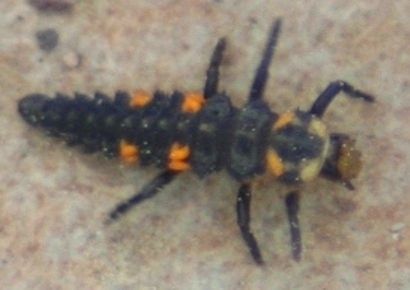 |
| Seven-spotted Ladybug Beetle larva, Durham (edge of marsh at neighborhood swamp), 4/11/06. This plump but nimble little rascal climbed rapidly over grass plants and other objects, readily bending in two. | Seven -spotted Ladybug Beetle larva, Duke Gardens, 3/28/07. This larva, much skinnier than the one on the left, appeared on the steps at the central terrace. |
 |
 |
 |
| Seven-spotted Ladybug Beetle pupa, Durham, NC, 5/1/08. Note the relatively smooth cast-off larval skin on the right. An adult Seven-spotted Ladybug Beetle was nearby. | Ladybug beetle pupa, Mason Farm Biological Reserve (area north of the creek), 4/28/07. Since there were 10+ Seven-spotted Ladybug Beetle adults in the immediate area, it seemed likely that this was one, too. | Seven-spotted Ladybug Beetle, in mid-metamorphosis between the larva and pupa states. Note that the legs are holding this insect to a grass stalk. Durham, NC, 4/26/09 |
Spotted Ladybug Beetle (Coleomegilla maculata, subfamily Coccinellinae)
 |
 |
 |
 |
 |
 |
 |
 |
 |
| Spotted Ladybug Beetle, Durham, NC, 7/16/20 | Another Spotted Ladybug Beetle, Durham, NC, 7/3/22 | Spotted Ladybug Beetle mating pair, Durham (neighborhood marsh), 6/18/05. This is the most abundant species by far in this marsh. | Spotted Ladybug Beetle mating pair, Durham, NC, 6/17/06, in my neighborhood marsh/swamp. | Spotted Ladybug Beetle, Durham, NC, 6/18/21 | Spotted Ladybug Beetle larva, Durham, NC, 5/28/19 | Spotted Ladybug Beetle larva, Durham, NC, 5/14/21 | Spotted Ladybug Beetle larva, Durham, 6/23/05, seen on a cattail leaf at the same marsh as the adult Coleomegilla maculata beetles above. | Spotted Ladybug Beetle, with what seem to be eggs. Durham, NC, 8/26/10 |
Spotted Ladybug Beetle (Coleomegilla maculata, most likely) Pupae
The sequence in the first row (ordered photos of different pupae, taken on one or two leaves of the same tree) illustrates the changes Ladybug Beetle pupae of one species go through. On the left is a new pupa, with the long, thin shape of a larva and some larva parts still showing. Later on, as the pupa matures, it takes on the round adult shape and the old larval body parts outside the pupa's shell disappear.
All of the pupae in the first row showed close to a swamp in my neighborhood. Although their species is unknown, they are almost certainly not Multi-colored Asian Ladybug Beetles. To judge from the species of the Ladybug Beetles seen in this vicinity, I would say they are most likely Coleomegilla maculata pupae.
|
||||||||||


Polished Ladybug Beetle (Cycloneda munda)
 |
 |
 |
 |
 |
 |
 |
 |
|
| Polished Ladybug Beetle (Cycloneda munda) with aphid prey, Durham, NC, 7/2/20 | Polished Lady Beetle, Durham, NC, 5/10/25 | Polished Ladybug Beetle, Durham, NC, 7/2/22 | Polished Ladybug Beetle (Cycloneda munda), Durham, NC, 6/20/20 | Polished Ladybug Beetle (Cycloneda munda), Johnston Mill Nature Preserve, Orange County, NC, 6/4/08 | Polished Ladybug Beetles, mating. Durham, NC, 9/24/20 | Polished Ladybug Beetle, Durham, NC, 5/4/22 | Polished Ladybug Beetle, Durham, NC, 11/18/21 |
Spotless Ladybug Beetle (Cycloneda sanguinea, Coccinellinae subfamily)
 |
 |
 |
 |
|||||
| Male Spotless Ladybug Beetle (Cycloneda sanguinea), Ocracoke, Hyde County, NC, 4/27/21 | Another male Spotless Ladybug Beetle (Cycloneda sanguinea), Ocracoke, Hyde County, NC, 4/26/21 | Female Spotless Ladybug Beetle (Cycloneda sanguinea), Ocracoke, Hyde County, NC, 4/26/21 | Another female Spotless Ladybug Beetle, Ocracoke, Hyde County, NC, 4/21/19 |
Painted Ladybug Beetle (Mulsantina genus, Coccinellinae subfamily)
 |
| Ladybug beetle (Mulsantina picta), Durham, NC, 6/15/14. ID thanks to Vassily Belov. |
Convergent Ladybug Beetle (Hippodamia convergens, subfamily Coccinellinae)
 |
 |
||
| Convergent Ladybug Beetle, Durham, NC, 9/13/08. Found in a power line cut. | Convergent Ladybug Beetle (Hippodamia convergens), Durham, NC, 5/22/21. Found in another power line cut. |
Twenty-spotted Ladybug Beetle (Psyllobora vigintamaculata, Coccinellinae subfamily)
 |
 |
 |
 |
| Twenty-spotted Lady Beetle, Durham, NC, 10/8/20 | Twenty-spotted Lady Beetle, Durham, NC, 12/26/23 | Twenty-spotted Lady Beetle larva, Durham, NC, 8/15/17. This one appeared at the edge of a wooded area about 300 feet above sea level. | Twenty-spotted Lady Beetle larva, Little Scaly Mountain, Macon County, NC, 8/9/05. ID based on Marshall (2006), p. 349. This beetle showed up at an altitude of about 4100 feet in far southwestern North Carolina. |
Vedalia Beetles (Rodolia cardinalis, Coccidulinae subfamily)
 |
 |
| Mating Vedalia Beetles, Ocracoke, Hyde County, NC, 4/20/19 | Vedalia Beetle larva, Ocracoke, Hyde County, NC, 4/21/19 |
Firefly Duskyling (Diomus terminatus, Scymninae subfamily)
 |
 |
 |
 |
 |
 |
 |
|
| Firefly Duskyling (Diomus terminatus), Durham, NC, 5/14/12. Tribe ID thanks to Vassili Belov. Species ID thanks to James Bailey, confirmed by Mike Quinn. | Firefly Duskyling (Diomus terminatus), Durham, NC, 5/1/22 | Firefly Duskyling (Diomus terminatus), Durham, NC, 6/11/19 | Firefly Duskyling (Diomus terminatus), Durham, NC, 2/22/18 | Firefly Duskyling (Diomus terminatus with aphid prey, Durham, NC, 8/27/19 | Same Firefly Duskyling (Diomus terminatus) with aphid prey | Firefly Duskylings (Diomus terminatus) mating, Durham, NC, 5/23/21 |
Mealybug Destroyer Beetles (Cryptolaemus montrouzieri, Scymninae subfamily)
 |
 |
 |
 |
|||||
| Mealybug Destroyer (Cryptolaemus montrouzieri) larva, with head showing, Greenville, Pitt County, NC, 7/28/17 | Same Mealybug Destroyer (Cryptolaemus montrouzieri) larva with four aphids, one of which the beetle is attacking. Greenville, Pitt County, NC, 7/28/17 | Mealybug Destroyer (Cryptolaemus montrouzieri), Durham, NC, 6/11/22 | Mealybug Destroyer larva (Cryptolaemus montrouzieri), a lady beetle, on Dogfennel, Durham, NC, 8/18/23 |
Mexican Bean Beetle: (Epilachna varivestris, Epilachninae subfamily)
 |
| Mexican Bean Beetle in an Old Salem vegetable garden, Winston-Salem, Forsyth County, NC, 7/25/14 |
Twice-stabbed Ladybug Beetles (Chilocorus genus, Chilocorinae subfamily)
 |
 |
 |
 |
|
| Twice-stabbed Ladybug Beetle (Chilocorus stigma), American Tobacco Trail, Durham, NC, 5/19/08. Alas, a rear view of this tiny (2 mm) beetle. | Kuwana's Ladybug Beetle (Chilocorus kuwanae), Durham, NC, 5/17/15 | Cactus Ladybug Beetle (Chilocorus cacti), Bailey Tract, Sanibel Island, Lee County, FL, 12/5/15 | Cactus Ladybug Beetle (Chilocorus cacti), Quinta Mazatlan, McAllen, Hidalgo County, TX, 11/16/19 |
Handsome Fungus Beetles (family Endomychidae, superfamily Cucujoidea, infraorder Cucujiformia, suborder Polyphaga)
 |
 |
|||||
| A handsome fungus beetle (Stenotarsus hispidus), Durham, NC, 6/25/17. ID thanks to Vassily Belov. | A handsome fungus beetle (Stenotarsus hispidus), Durham, NC, 8/8/21 |
Pleasing Fungus Beetles (subfamily Erotylinae, family Erotylidae, superfamily Cucujoidea, infraorder Cucujiformia, suborder Polyphaga)
 |
 |
 |
 |
||
| Ischyrus quadripunctatus, Durham, NC, 5/9/08 | Another beetle (probably Megalodacne heros) Duke Gardens, 7/24/05. This beetle was about one inch long and showed up at the far end of the Asian garden. | Clover Stem Borer (Languria mozardi), Durham, NC, 5/17/20 | Clover Stem Borer (Languria mozardi), North Carolina Botanical Garden, Orange County, NC, 4/4/23 |
Leaf Rolling Weevils (family Attelabidae, superfamily Curculionoidea, infraorder Cucujiformia, suborder Polyphaga)
 |
|||||
| Leaf rolling weevil (Attelabus bipustulatus), about 3 mm long, Haw River State Park, Rockingham County, NC, 5/31/08 |
Snout Beetles (family Curculionidae, superfamily Curculionoidea, infraorder Cucujiformia, suborder Polyphaga)
There are about 50,000 species of curculionid snout beetles, also called weevils. They are surprisingly easy to find, especially in brushy power line cuts. If most species weren't so tiny, we'd probably be swimming in them, especially if it weren't for ambush bugs, which lie in wait on flowering plants in brushy areas! Nevertheless, there are some notable exceptions to the size rule: some weevils are almost an inch long.
Curculioninae subfamily
 |
 |
 |
 |
|
| Nut/acorn weevil (Curculio proboscideus), Durham, NC, 8/9/10. Proboscis alone was about an inch long. | Ash seed weevil (Lignyodes fraxini). Genus ID thanks to Vassily Belov. Durham, NC, 12/30/18 | Yellow Poplar Weevil (Odontopus calceatus), Durham, NC, 9/16/20 | Yellow Poplar Weevil (Odontopus calceatus) on American Black Elderberry, Durham, NC, 5/28/19. ID thanks to Vassily Belov. |
Conoderinae subfamily
 |
 |
 |
|||||
| Weevil (Lechriops oculatus), Durham, NC, 11/8/21. ID thanks to Blaine Mathison. | Weevil (Lechriops oculatus), Durham, NC, 10/29/22 | Weevil (Lechriops oculatus), Durham, NC, 12/09/23 |
Ceutorhynchinae subfamily
 |
|||||
| Minute seed weevil (best guess: Perigaster obscura), Durham, NC, 1/10/24 |
Baridinae subfamily
 |
|||||
| Weevil (Barinus curticollis), about 3 mm long, Durham, NC, 6/27/09. Seen in local marsh. Genus ID thanks to Blaine Mathison. |
Dryophthorinae subfamily
 |
 |

|

|
|||||
| Billbug (Splenophorus venatus vestis), Durham, NC, 6/13/20 | Billbug (Splenophorus venatus vestis), Durham, NC, 6/8/09 | Billbug (Sphenophorus genus), Durham, NC, 6/5/14, playing dead. ID thanks to Steve Scholnick. | Billbug (Splenophorus venatus), Durham, NC, 6/30/11 |
 |
 |
 |

|
||
| Mating Cocklebur Weevils (Rhodobaenus quinquepunctatus), Durham, NC, 7/12/20 | Cocklebur Weevil (Rhodobaenus quinquepunctatus), Durham, 8/10/24 | Cocklebur Weevil (Rhodobaenus quinquepunctatus), Durham, 7/8/08 | Tiny weevil on individual Butterfly Weed flower, Penny's Bend Nature Preserve, Durham County, NC, 6/25/11 |
Entiminae subfamily
 |
 |
 |
|
| White-fringed Weevil (Naupactus leucoloma) | White-fringed Weevil (Naupactus leucoloma), Greenville, Pitt County, NC, 9/20/08. | Broad-nosed Weevils (Naupactus genus), Johnston Mill Nature Preserve, Orange County, NC, 8/31/07 |
Lixinae subfamily
 |
 |
 |
 |
 |
|
| Mating Rhubarb Weevils, aka Rhubarb Curculios (Lixus concavus), Durham, NC, 5/12/15 | Rhubarb Weevil (Lixus concavus), Durham, NC, 11/10/21 | Rubarb Weevil (Lixus concavus), Durham, NC, 6/8/12 | Rhubarb Weevil (Lixus concavus), Durham, NC, 9/7/08 | Weevil (Lixus macer), Durham, NC, 7/27/24 |
Primitive or Straight-snouted Weevils (family Brentidae, superfamily Curculionoidea, infraorder Cucujiformia, suborder Polyphaga)
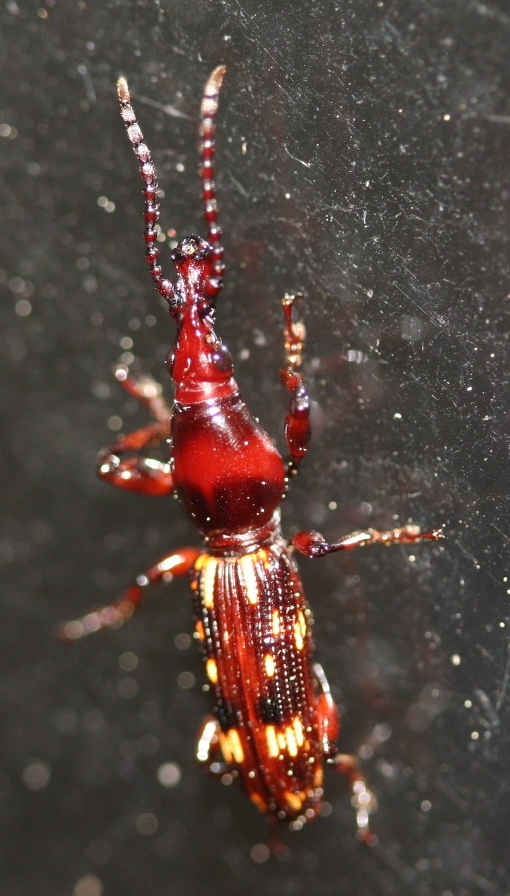 |
 |
| Oak Timberworm (Arrhenodes minutus), a type of straight-snouted weevil. It was about 18 mm long and brown in regular light (photo taken at night). ID thanks to John and Jane Balaban. See more information at the Forest Pests Oak Timberworm Page. | Oak Timberworm (Arrhenodes minutus), another view |
Fungus Weevils (family Anthribidae, superfamily Curculionoidea, infraorder Cucujiformia, suborder Polyphaga)
 |
 |
| Euparius marmoreus, Falls Lake SP, Wake County, NC, 3/1/06. This beetle appeared near the end of a pier. | Touching the beetle caused it to play dead briefly, after which it righted itself after some leg-wiggling. |
 |
|||||
| Fungus beetle (Eurymycter fasciatus, Anthribinae subfamily), Durham, NC, 5/24/13 |
Checkered Beetles (family Cleridae, superfamily Cleroidea, infraorder Cucujiformia, suborder Polyphaga)
 |
 |
 |
 |
|
| Checkered beetle (Enoclerus ichneumoneus), Penny's Bend Nature Preserve, Durham County, NC, 4/4/09. ID thanks to John and Jane Balaban. | Checkered beetle (Enoclerus rosmarus), Durham, NC, 5/19/10 | Checkered beetle (Enoclerus rosmarus), Durham, NC, 7/20/20 | Checkered beetle (Pelonides quadripunctata), Nature Trail, North Carolina Botanical Garden, Orange County, NC, 4/12/23 |
Soft-winged Flower Beetles (family Melyridae, superfamily Cleroidea, infraorder Cucujiformia, suborder Polyphaga)
 |
 |
 |
||
| Soft-winged flower beetle (Collops genus), Durham, NC, 7/15/09 | Soft-winged flower beetle (Collops genus). Seen in neighborhood marsh. Durham, NC, 8/23/08 | Tiny beetle (Hypebaeus bicolor). Eno River State Park, Old Cole Mill Road access, 4/24/09 |
Leaf Beetles (family Chrysomelidae, superfamily Chrysomeloidea, infraorder Cucujiformia, suborder Polyphaga)
Some Leaf Beetles, such as the Colorado Potato Beetles, were major crop pests because they were imported from outside North America while their natural predators were left behind. Leaf Beetles in general are far less common than they used to be as a result of insecticide use. However, they are still found munching on a variety of weeds and marsh vegetation in my neighborhood and at least a few other places.
Tribe assignments for Tortoise Beetles are taken from the Alabama Agricultural Experiment Station, Auburn University web page. Most of the subfamily IDs are based on University of Minnesota's Insects of Cedar Creek.
Legume Weevils (Subfamily Bruchinae)
 |
 |
|||||
| Redbud Bruchid (Gibbobruchus mimus) on goldenrod. Species ID thanks to Skip Blanchard, tribe ID by John Rosenfeld. | Seed beetle (Althaeus hibisci), inside Swamp Mallow (Hibiscus moscheutos), Durham, NC, 7/26/23 |
Aquatic Leaf Beetles (Subfamily Donaciinae)
 |
|||||
| Aquatic Leaf Beetle (Donacia genus, Donacocia subgenus), West Point on the Eno, Durham, NC, 7/4/09 |
Tortoise Beetles and the Hispines (Subfamily Cassidinae)
Cassini tribe
 |
 |
 |
 |
 |
 |
 |
 |
|
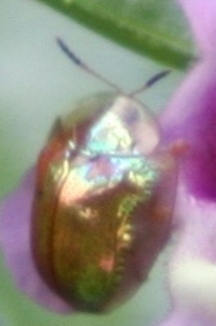
| Golden Tortoise Beetle (Charidotella sexpunctata bicolor), Durham, NC, 7/1/07. These are photos of the same beetle, taken in different lighting. The "shell" is transparent on the left and reflective on the right. | Golden Tortoise Beetle (Chariodotella sexpunctata, tribe Cassidini, sub-family Cassidinae), Duke Gardens, 7/24/05. Thanks to Rob Westerduijn, Iquitos, Peru for genus and species names. Thanks to Jeff Pippen for the subfamily ID. | Golden Tortoise Beetle (Charidotella sexpunctata bicolor), Durham, NC, 8/4/18 | Mottled Tortoise Beetle (Deloyala guttata), Durham, NC, 8/04/20 | Mottled Tortoise Beetle (Deloyala guttata), Durham, NC, 8/14/18 | Clavate Tortoise Beetle (Plagiometriona clavata), Durham, NC, 8/5/22 | Palmetto Tortoise Beetle (Hemisphaerota cyanea), South Lido Park, Sarasota County, FL, 1/26/17 | ||
Clavate Tortoise Beetle larvae (Plagiometriona clavata)
 |
 |
 |
| Clavate Tortoise Beetle larva, Durham, NC, 7/6/07. This insect was about 3 mm long. ID thanks to Donald S. Chandler. | Same beetle, seen from below | Same beetle, seen from above |
Tribe Stolaini
Argus Tortoise Beetle (Chelymorpha cassidea)
 |
| Argus Tortoise Beetle (Chelymorpha cassidea, tribe Stolaini, subfamily Cassidinae), north shore of Ocracoke Island, 5/15/05. This beetle was about half an inch long. Not sure of this ID. |
Tribe Chalepini
Leaf-mining Leaf Beetles
 |
 |
 |
 |
 |
 |
|
| Leaf-mining leaf beetle (Sumitrosis inaequalis), Durham, NC, 11/11/21 | Leafmining leaf beetle (Sumitrosis inaequalis), Durham, NC, 5/10/17 | Leaf-mining leaf beetle (Sumitrosis inaequalis), Durham, NC, 10/07/10 | A Locust Leafminer Beetle (Odontata dorsalis) working on a leaf near Abbott Lake, Peaks of Otter, Bedford County, VA, 7/18/12. Adults skeletonize leaves to some extent, but most damage is done by larvae. | Locust Leafminer beetle (Odontota dorsalis), Linn Cove Viaduct, Tanawha Trail, Avery, NC, 7/1/10 | Locust Leafminer Beetle (Anisostena ariadne), Durham, NC, 11/13/21 |
Subfamily Eumolpinae
 |
 |
 |
 |
 |
 |

|
|
| Dogbane Beetles mating, Durham, NC, 7/13/22 | Dogbane Beetle (Chrysochus auratus), Durham, NC, 6/29/22 | Mating Dogbane Beetles (Chrysochus auratus), Daniel Boone Gardens, Boone, Watauga County, NC, 7/8/11 | Dogbane Beetle (Chrysochus auratus), Flat River Impoundment, Durham County, NC, 6/3/11 | Dogbane Beetle (Chrysochus auratus), Occoneechee Mountain, Orange County, NC. It was about ½ inch long. These beetles only eat milkweed and dogbane. | Dogbane Beetle (Chrysochus auratus), Durham, NC, 7/1/21 | Dogbane Beetle, Daniel Boone Gardens, Watauga County, NC, 8/17/15 |
 |
 |
 |
 |
 |
|||
| Leaf beetle, probably a Strawberry Rootworm (Paria fragariae), Durham, NC, 11/26/20 | Strawberry Rootworm (Paria fragariae), Durham, NC, 5/4/20 | Leaf beetle (Paria quadrinotata), Durham, NC, 4/14/09 | Leaf beetle (Paria quadrinotata), Johnston Mill Nature Preserve, Orange County, NC, 5/11/07. | Might be a Grape Rootworm beetle, Durham, NC, 6/30/08. There were a lot of Wild Grape vines in the general area. |
Skeletonizing Leaf Beetles (Subfamily Galerucinae)
Flea Beetles (Alticini tribe)
Disonycha genus
 |
 |
 |
 |
 |
| Flea Beetle (Disonycha fumata), Durham, NC, 4/19/06. This beetle was visiting a dandelion. | Flea beetle (Disonycha glabrata), Durham, NC, 7/6/07. A very tiny beetle. | Flea beetle (Disonycha procera), Durham, NC, 11/18/21 | Flea beetle (Disonycha procera), Durham, NC, 7/7/212 | Flea beetle (Disonycha procera), Durham, NC, 5/9/22 |
Strabala rufa
 |
|||||
| Flea beetle (Strabala rufa), Durham, 7/15/05. |
Kuschelina scripticollis
 |
 |
||
| Flea beetle (Kuschelina scripticollis), Durham, NC, 5/4/20 | Flea beetle, (Kuschelina scripticollis, subfamily Galerucinae), White Pines Nature Preserve, Chatham County, NC, 4/16/06. Thanks to Eric Eaton and Mike Quinn for genus and species names, respectively. |
Parchicola tibialis

|
|||||
| Flea beetle (Parchicola tibialis), Johnston Mill Nature Preserve, Orange County, NC, 7/2/11. ID thanks to Vassily Belov. |
Cerataltica insolita
 |
|||||
| Flea beetle (Cerataltica insolita), Durham, NC, 10/24/20. ID thanks to Vassily Belov. |
Altica genus
 |
|||||
| Flea Beetle (Altica genus), about 2 mm long. Thanks to Rob Westerduijn for ID. |
Red-headed Flea Beetle (Systena frontalis)
 |
|||||
| Red-headed Flea Beetle (Systena frontalis), Durham, NC, 8/5/22 |
Section Schematizites
Ophraella sexvittata
 |
|||||
| Flea beetle (Ophraella sexvittata), Durham, NC, 8/2/22 |
Section Coelomerites
Larger Elm Leaf Beetle (Monocesta coryli)
 |
 |
 |
 |
 |
|||||
| Larger Elm Leaf Beetle adult, Durham, NC, 7/28/24 | Larger Elm Leaf Beetle adult, Durham, NC, 5/30/23 | Larger Elm Leaf Beetle (Monocesta coryli) larva, Durham, NC, 9/7/22 | Another Larger Elm Leaf Beetle (Monocesta coryli) larva, Durham, NC, 9/7/22 | Larger Elm Leaf Beetle larvae (17 of them), Durham, NC, 9/12/22 |
Trirhabda genus
 |
 |
|
| Flea beetles (Trirhabda bacharidis), Durham, NC, 6/22/07. Genus ID thanks to Rob Westerduijn. | Flea beetle larva (Trirhabda bacharidis), North Charleston, SC, 3/28/06 |
Crepidodera browni
 |
| Tiny beetle, Crepidodera browni, Durham, NC, 11/13/17. Genus ID thanks to Margarethe Brummermann, confirmed by Blaine Mathison. |
Capraita genus
 |
 |
| Flea beetle (Capraita sexmaculata, Alticini tribe, Galerucinae subfamily, Chrysomelidae family). A kind of leaf beetle. | Flea beetle (Capraita obsidiana). ID thanks to John Rosenfeld. |
Spotted Cucumber Beetles (Luperini tribe)
Diabrotica undecimpunctata
 |
 |
 |
 |
 |
| This illustrates some interesting similarities. A Spotted Cucumber Beetle, at right, shared flower nectar with a (mainly carnivorous) ladybug beetle (Coleomegilla maculata) on 7/2/05. | Spotted Cucumber Beetle, Durham, NC, 7/29/07 | Spotted Cucumber Beetle, Durham, NC, 7/15/09 | Spotted Cucumber Beetle, Mason Farm Biological Reserve, Orange County, NC, 11/22/11 | Spotted Cucumber Beetle, Pitt County Arboretum, Greenville, NC, 11/13/11 |
Bean Leaf Beetles (Cerotoma trifurcata, Luperini trube)
 |
 |
 |

|
|||||
| Bean Leaf Beetle, Durham, NC, 4/26/23 | Bean Leaf Beetle, Durham, NC, 5/6/17 | Bean Leaf Beetle, Durham, NC, 5/6/17. ID thanks to Brandon Woo. | Bean Leaf Beetle, Durham, NC, 10/12/13. Color suggests it wasn't getting enough to eat. |
Ophraella genus, Galerucini tribe
 |
 |
|
| Skeletonizing leaf beetle (Ophraella conferta), Durham, NC, 8/2/20 | Beetle (Ophraella communa), Durham, NC, 9/22/07 |
Broad-bodied Leaf Beetles (Subfamily Chrysomelinae)
Leptinotarsa genus
 |
 |
 |
 |
|
| Burdock Beetle or False Potato Beetle (Leptinotarsa juncta). I found this beetle munching on a leaf of one of my least favorite weeds (Horse Nettle). Durham, 9/27/05. Thanks to Eric Eaton for ID. | Burdock Beetle (Leptinotarsa juncta), Durham, NC, 6/30/16 | Colorado Potato Beetle (Leptinotarsa decemlineata), Flat River Impoundment, Durham County, NC, 6/3/11 | Beetle (Leptinotarsa genus) larva, Durham, NC, 5/23/20 |
Trachymela genus
 |
|||||
| Australian Tortoise Beetle (Trachymela sloanei), San Anselmo, Marin County, CA, 4/29/17. ID thanks to Vassily Belov. |
Calligrapha genus
 |
 |
|||||
| Calligrapha bidenticola beetles mating, Durham, NC, 8/18/20 | Calligrapha bidenticola, Durham, NC, 7/12/20 |
Zygogramma genus
 |
|||||
| Ragweed Leaf Beetle (Zygogramma suturalis), Durham, NC, 8/13/20 |
Swamp Milkweed Leaf Beetles (Labidomera clivicollis)
 |
 |
 |
 |
 |
|||||
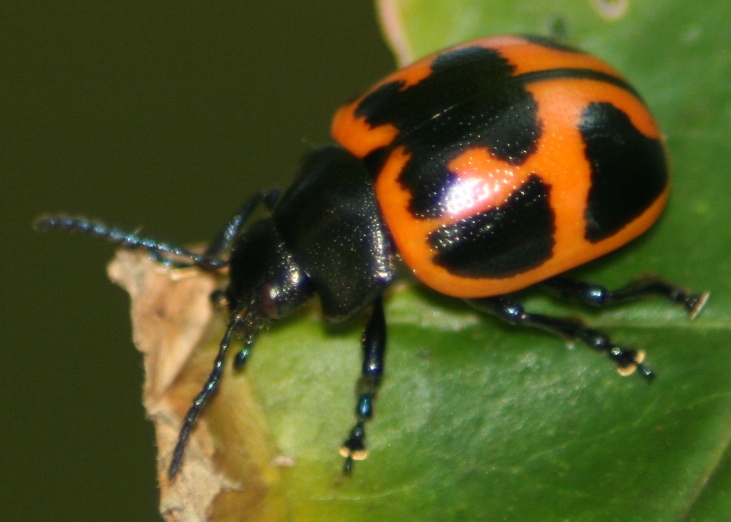
| Swamp Milkweed Beetle (Labidomera clivicollis), Durham, NC, 8/10/24 | Swamp Milkweed Beetle, Durham, NC, 5/31/18 | Swamp Milkweed Beetle, Durham, NC, 7/28/18 | Swamp Milkweed Leaf Beetle, Eno River State Park, Orange County, NC, 10/9/06 | Swamp Milkweed Leaf Beetles mating, Durham, NC, 5/10/19 |
 |
 |
 |
 |
 |
| Swamp Milkweed Beetle larva, Durham, NC, 6/18/21 | Swamp Milkweed Leaf Beetle larva, Durham, NC, 5/23/21 | Swamp Milkweed Beetle larva, Durham, NC, 7/2/22 | Swamp Milkweed Beetle larva, Durham, NC, 7/13/22 | Swamp Milkweed Beetle larva, Durham, NC, 6/11/21 |
Microtheca genus
 |
 |
|
| Mating Yellow-margined Leaf Beetles (Microtheca ochroloma, subfamily Chrysomelinae), Durham, NC, 5/8/08 | Yellow-margined Leaf Beetle (Microtheca ochroloma), Durham, NC, 9/23/09. Seen on a blade of grass near a marsh after a heavy rain. |
Prasocuris phellandri
 |
 |
|||||
| Beetle, about 2 mm. Durham, NC, 5/4/09 | Beetle (maybe Prasocuris phellandri), Durham, NC, 5/19/19 |
Cottonwood Leaf Beetle (Chrysomela scripta)
 |
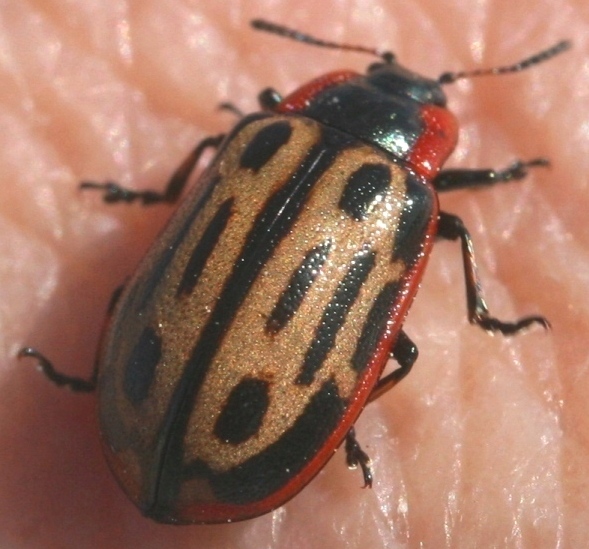 |
| Cottonwood Leaf Beetle (Chrysomela scripta), Durham, NC, 7/14/19 | Cottonwood Leaf beetle (Chrysomela scripta), seen at the observation tower at the summit of Moore's Knob, Hanging Rock State Park, Stokes County, NC, 4/11/10, far from anything with leaves on it. |
Calligrapha confluens
 |
|||||
| Calligraphic Leaf Beetle (Calligrapha confluens), Black Balsam Knob, Blue Ridge Parkway Milepost 420, NC, 6/1/11. Photo by Rain Parker. |
Case-bearers, i.e., Cylindrical Leaf Beetles, Warty Leaf Beetles and Short-horned Leaf Beetles (Subfamily Cryptocephalinae)
They are called "cryptocephalid" because of the "hidden" orientation of their heads. Females cover their eggs with their feces, which become a "case" that the growing larva builds on.
Chlamisini tribe

|
 |
 |
 |
 |
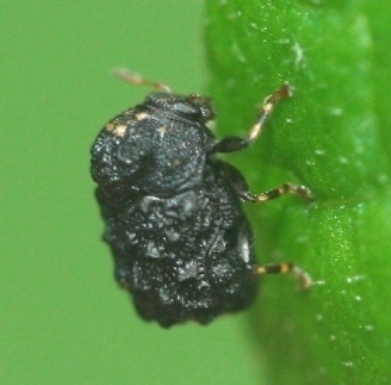 |
|
| Warty leaf beetle (Neochlamisus eubati), Durham, NC, 6/7/14. Species is a guess. | Warty leaf beetle (Neochlamisus eubati), Durham, NC, 5/5/22 | Warty leaf beetle (Neochlamisus bebbianae), Durham, NC, 4/24/20. Species is a guess. | Warty leaf beetle (Neochlamisus bebbianae), Durham, NC, 10/9/16 | Warty leaf beetle (Neochlamisus bebbianae), Durham, NC, 5/10/08. Although most insects (and some treefrogs) seem to mimic dead leaves, this beetle is typically confused with caterpillar droppings, but only when it tucks its legs under it and lies motionless! | Warty leaf beetle (possibly Exema genus), Johnston Mill Nature Preserve, Orange County, NC, 6/4/08. |
Clytrini tribe
 |
 |
 |
 |
|||||
| Cylindrical Leaf beetle (Babia quadriguttata, tribe Clytrini), Durham, 6/2/06. | Clay-colored Leaf Beetle (Anomoea laticlava), Prairie Ridge Ecostation, Raleigh, Wake County, NC, 5/20/15 | Clay-colored Leaf Beetle (Anomoea laticlavia, tribe Clytrini), Penny's Bend Nature Preserve, Durham County, NC, 6/15/07. Family ID thanks to Jim McClarin. | Probably another Clay-colored Leaf Beetle, Indian Creek Trail, a Jordan Lake Game Land, Chatham County, NC, 7/7/06 |
Cryptocephalini tribe
 |
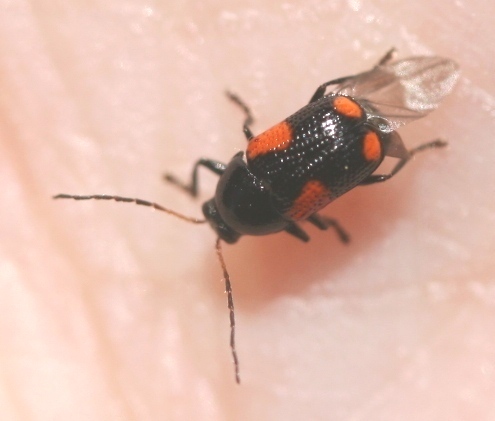 |
 |
 |

|
|||||
| Fourteen-spotted Leaf Beetle (Cryptocephalus guttulatus), about 4 mm long. Durham, NC, 7/31/10 | Leaf beetle (Cryptocephalus quadriplex). Durham, NC, 5/17/08 | Cryptocephalid beetle (Bassareus detritus), North Carolina Botanical Garden, Chapel Hill, Orange County, NC, 6/13/18 | Leaf beetle (Bassareus detritus), Durham, NC, 5/15/22 | Scriptured leaf beetle (Pachybrachis nigricornis). Genus ID thanks to Margarethe Brummerman. |
Case-bearer Beetle Larvae
Casebearer beetle larvae cover nearly all of their bodies except their legs with a case made of their own fecal matter, eventually carrying themselves mostly upright. When they mature, they struggle out of the case and become pupae.
 |
 |
 |
 |
 |
 |
 |
| Case-bearer beetle larva (Lema genus), Greenville, NC, 9/20/08. A relatively early instar. ID thanks to Charley Eiseman and Blaine Mathison. | Case-bearer beetle larva, about 3 mm long, emerging from its case. Third Fork Trail, Durham, NC, 7/2/11 | Case-bearer beetle larva, Durham, NC, 6/12/21 | Case-bearer beetle larva, Penny's Bend, Durham County, NC, 6/4/06. | Case-bearer beetle larva, Durham, NC, 6/20/05. | Case-bearer beetle larva, Durham, NC, 6/17/07. You can just barely see the little legs near the bottom. | Casebearer beetle larva, Jordan Lake Gameland, Chatham County, NC, 6/19/07. You can see the little legs at the bottom. |
Shining Leaf Beetles (Criocerinae subfamily)
These have no relation to the Shining Leaf Chafers of the Scarabaeidae family. These are less than ¼ inch long.
 |
 |
 |
 |
 |
 |
 |
|
| Female Six-spotted Shining Leaf Beetle (Neolema sexpunctata), Durham, 5/6/09 | Male Six-spotted Shining Leaf Beetle (Neolema sexpunctata), Durham, NC, 7/1/07 | Six-spotted Shining Leaf Beetle (Neolema sexpunctata), with numerous colorless mites. Durham, NC, 8/27/21 | Six-spotted Shining Leaf Beetle, Durham, NC, 8/20/22 | Shining leaf beetle, Mason Farm Biological Reserve, Orange County, NC, 5/4/08 | Shining leaf beetle (Lema solani). ID thanks to Blaine Mathison. Durham, NC, 6/2/18 | Shining leaf beetle (Lema solani), Durham, NC, 5/19/19 |
Long-horned Beetles (family Cerambycidae, superfamily Chrysomeloidea, infraorder Cucujiformia, suborder Polyphaga)
Flower Longhorns (Lepturinae subfamily)


 |
 |
 |
 |
 |
||
| Flower Longhorn Beetle (Strangalepta abbreviata), Johnston Mill Nature Preserve, 6/4/08 | Longhorn Beetle, Hanging Rock State Park, Stokes County, NC, 6/18/09. Top black spots may have been rubbed off. | Flower longhorn beetle (Encyclops caerulea), Glassmine Gap Trail, Macon County, NC, 5/28/13 | Flower longhorn beetle (Charisalia americana), Durham, NC, 5/22/20 | Ribbed Pine Borer (Rhagium inquisitor), Weymouth Woods-Sandhills Nature Preserve, Moore County, NC, 3/18/22 |
Cerambycinae subfamily
 |
 |
| Locust Borer (Megacyllene robiniae), Boone, Watauga County, NC, 8/29/05. | Locust Borer (Megacyllene robiniae), Boone, Watauga County, NC, 8/7/06 |
 |
|||||
| Cyrtophorus verrucosus, a carpenter ant mimic, both in size and movement. Durham, NC, 4/2/24 |
 |
| Elaphidion mucronatum. ID thanks to Frank Guarnieri. Durham, NC, 5/22/09 |
 |
|
| Rustic Borer (Xylotrechus colonus), Durham, NC, 6/27/10. Photo taken at night. |
 |
|||||
| Red-headed Ash Borer (Neoclytus acuminatus) Durham, NC, 4/5/20. ID thanks to Jerry Finlayson. |
 |
||
| Longhorn beetle (Ancylocera bicolor), Raulston Arboretum, Raleigh, NC, 6/9/06. ID thanks to Sean McCann. |
 |
 |
 |
|||
| Longhorn beetle (Euderces pini), Third Fork Creek Trail, Durham, NC, 5/16/13 | Long-horned beetle (Euderces pini, Tillomorphini tribe), Eno River State Park, Old Cole Mill Road access, 4/4/07 | Longhorn beetle (Euderces pini), Durham, NC, 4/22/25 |
 |
 |
|||||
| Longhorn beetle (Molorchus bimaculatus) on Smooth Blackhaw (Viburnum prunifolium), Nature Trail, North Carolina Botanical Garden, Orange County, NC, 4/4/23 | Longhorn beetle (Molorchus bimaculatus) on Smooth Blackhaw (Viburnum prunifolium), Nature Trail, North Carolina Botanical Garden, Orange County, NC, 4/12/23 |
Lamiinae subfamily
 |
 |
 |
 |
 |
|
| Flat-faced Longhorned Beetle (Aegomorphus quadrigibbus), Eno River SP, Old Cole Mill Road access, 7/30/05. ID thanks to Eric Eaton and Dr. Doug Yanega of the University of California at Riverside. | Same Flat-faced Longhorn Beetle. | Flat-faced Long-horned Beetle (Aegomorphus genus), Durham, 7/1/06 | Beetle awaiting an ID, White Pines Nature Preserve, Chatham County, NC, 4/16/06. | Flatfaced longhorn beetle (Cyrtinus pygmaeus). ID thanks to Brad Barnd. |
 |
||
| Flat-faced longhorn beetle (Hemierana marginata argens, Hemilophini tribe). ID thanks to Mike Thomas. |
Prioninae subfamily
 |
||
| Brown Prionid (Orthosoma brunneum, Prionini tribe), Durham, NC, 7/7/08. This beetle looked brown to me. This photo taken at night, and use of the flash showed that the beetle's body surface reflects red light. I wonder if this is part of the beetle's strategy to deflect infrared light, since its large body is otherwise vulnerable to overheating in this hot weather. |
Tumbling Flower Beetles (family Mordellidae, superfamily Tenebrionoidea, infraorder Cucujiformia, suborder Polyphaga)
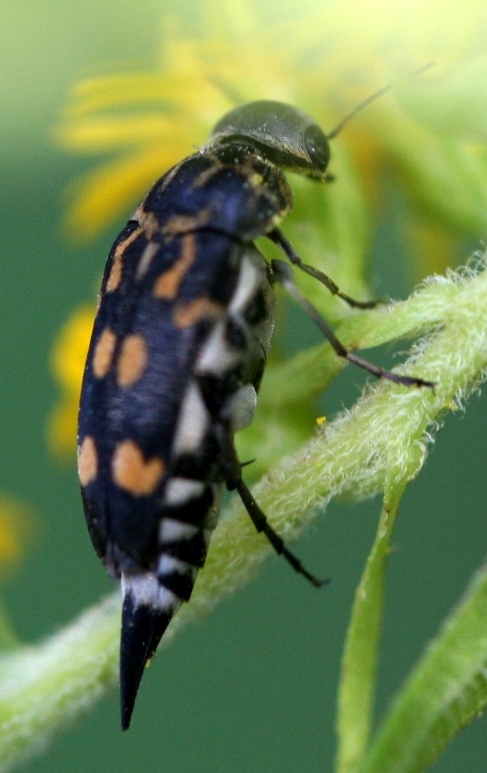 |
 |
 |
 |
 |
 |
| Eight-spotted Tumbling Flower Beetle (Hoshihananomia octopunctata), Durham, NC, 8/11/08. These photos illustrate the odd head shape (flat on the bottom) and how that head moves. This beetle was about 5 mm long. | Tumbling Flower Beetle (Mordellistena comata), Durham, NC, 6/4/20 | Tumbling flower beetle (Mordellistena masoni, Durham, NC, 6/1/21 | Tumbling flower beetle (Mordellistena trifasciata, Durham, NC, 7/1/22 | Tumbling Flower Beetle (Falsomordellistena hebraica), Durham, NC, 6/11/22. ID thanks to Boris Büche | |
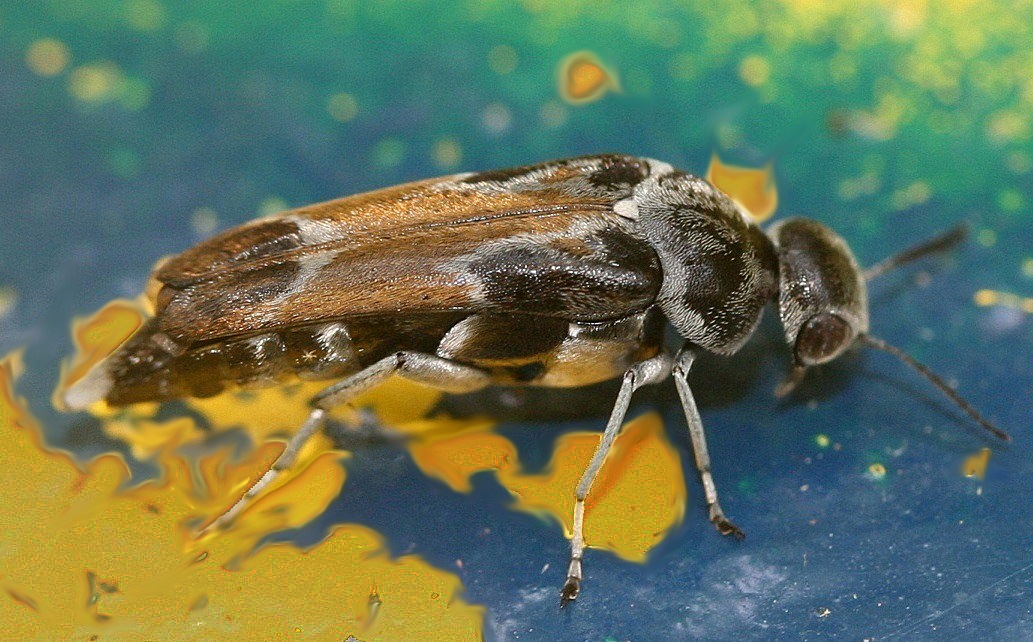
|
 |

|
 |
|||||
| Tumbling flower beetle (Glipa hilaris), Durham, NC, 7/2/12. ID thanks to Ken Wolgemuth. | Tumbling flower beetle (Mordella genus?) on Queen Anne's Lace, Johnston Mill Nature Preserve, Orange County, NC, 6/24/09 | Tumbling flower beetle on Queen Anne's Lace. Penny's Bend Nature Preserve, Durham County, NC, 6/25/11 | Tumbling flower beetle, Durham, NC, 6/2/25 |
Wedge-shaped Beetles (family Ripiphoridae, superfamily Tenebrionoidea, infraorder Cucujiformia, suborder Polyphaga)
 |
 |
| Macrosiagon cruenta, Penny's Bend, 6/4/06. Family ID thanks to Jim McClarin. | Macrosiagon cruenta, same place and time |
 |
| Wedge-shaped Beetle (Macrosiagon limbata), Boone Gardens, Watauga County, NC, 8/12/09 |
Blister Beetles (family Meloidae, superfamily Tenebrionoidea, infraorder Cucujiformia, suborder Polyphaga)
 |
 |
 |
 |
 |
| Margined Blister Beetle (Epicauta pestifera), Occoneechee Mountain, Orange County, NC, 8/12/06. ID thanks to Lynette Schimming. | Margined Blister Beetle (Epicauta pestifera), Mason Farm Biological Reserve, Orange County, NC, 9/1/07 | Blister beetle (Nemognatha genus, species probably piazata), Fort Fisher, New Hanover County, NC, 6/22/06. ID thanks to Stanislav Krejcik. Confirmed by BugGuide. | Blister Beetle (Lytta aenea, tribe Lyttin), Durham, NC, 4/23/08 | Black Blister Beetle (Epicauta pennsylvanica), Penny's Bend Nature Preserve, Durham County, 8/31/08 |
Darkling Beetles (family Tenebrionidae, superfamily Tenebrionoidea, infraorder Cucujiformia, suborder Polyphaga)
 |
 |
 |
|
| Long-jointed Beetle (Arthromacra aenea, subfamily Lagriinae), a darkling beetle. The park was full of these beetles. Hanging Rock State Park, Stokes County, NC, 6/18/09 | Hairy fungus beetle (Litargus tetraspilotus), Durham, NC, 5/5/19. ID thanks to John Schneider | Hairy fungus beetle (Litargus tetraspilotus), Durham, NC, 6/8/23 |
False Blister Beetles (family Oedemeridae, superfamily Tenebrionoidea, infraorder Cucujiformia, suborder Polyphaga)
 |
 |
|
| False blister beetle (Xanthochroa lateralis), Durham, NC, 5/19/10. Family ID thanks to Blaine Mathison. ID thanks to Vassily Belov. Info about this family: Ross H. Arnett's account. | False blister beetle (Asclera puncticollis) |
Carpet Beetles (family Dermestidae, superfamily Bostrichoidea, infraorder Bostrichiformia, suborder Polyphaga)
 |
 |
 |
 |
 |
||
| Varied Carpet Beetle (Anthrenus verbasci, tribe Anthrenini, subfamily Anthreninae), 1 or 2 mm long. ID thanks to John R. Maxwell. | Varied Carpet Beetle (Anthrenus verbasci, tribe Anthrenini, subfamily Anthreninae), Ocracoke, Hyde County, NC, 4/23/16 | Varied Carpet Beetle (Anthrenus verbasci), with what are apparently exuviae, i.e., cast-off exoskeletons from its pupal stage. Durham, NC, 3/12/26 | Rove beetle (Oxypoda genus) and Buffalo Carpet Beetle (Anthrenus scrophulariae), North Carolina Botanical Garden, Orange County, NC, 4/4/23 | Carpet beetle (Anthrenus thoracicus), Nature Trail, North Carolina Botanical Garden, Orange County, 4/12/23 |
Passalid Beetles or Bess Beetles (family Passalidae, superfamily Scarabaeoidea, infraorder Scarabeiformia, suborder Polyphaga)
Adult beetles live under rotting logs and chew up the wood so their offspring can eat it.
 |
| Horned Passalus (Odontotaenius disjunctus), Durham, NC, 5/1/19 |
Scarab Beetles (family Scarabaeidae, superfamily Scarabaeoidea, infraorder Scarabeiformia, suborder Polyphaga)
These beetles perform an essential clean-up function: the adults move the feces of other animals underground, where they store it as food for themselves and their offspring.
Currently for this family, the ITIS does not list any taxa below subfamily for any species assigned to a subfamily. However, the relevant genus and species names are in common use.Rhinoceros Beetles (subfamily Dynastinae)
 |
 |
 |
|
| Rhinoceros beetle (Xyloryctes jamaicensis), Third Fork Trail, Durham, NC, 7/29/11 | Ox beetle (Strategus genus, maybe antaeus species), Carolina Beach State Park, New Hanover County, NC, 9/28/10 | Triceratops Beetle (Phileurus truncatus), Durham, NC, 7/20/07. Taken at night. Genus ID thanks to Maury J. Heiman, species ID thanks to Michael C. Thomas. |
Tumblebugs/Dung Beetles (subfamily Scarabaeinae)
 |
 |
 |
 |
| Dung beetle (Canthon imitator), Carolina Beach State Park, New Hanover County, NC, 5/13/10 | Dung beetle (Canthon simplex), pushing a clump of dung along with its hind legs at Eno River SP, Old Cole Mill Road access, 5/29/05. | Male Dung beetle (Onthophagus hecate hecate) , Durham, NC, 8/13/07. The pronotal horn is distinctive. ID thanks to Will Merritt. | Dung beetle (Copris fricator), Fort Fisher Recreational Area, New Hanover County, NC, 3/9/10 |
Shining Leaf Chafers (subfamily Rutelinae)
Researchers at the U. of Nebraska at Lincoln are doing phylogenetic research on the genera of the Rutelinae subfamily.
 |
 |
 |
 |
 |

|
 |
 |
|
| Grapevine Beetle (Pelidnota punctata, tribe Rutelini, subfamily Rutelinae), Durham, 7/20/07. | Ant attacking a Rose Chafer Beetle (Macrodactylus subspinosus), Nature Trail, North Carolina Botanical Garden, Orange County, NC, 6/21/22 | Another Rose Chafer Beetle, Nature Trail, North Carolina Botanical Garden, Orange County, NC, 6/21/22 | Rose Chafer Beetle (Macrodactylus subspinosus), Indian Creek Trail, a Jordan Lake Game Land, Chatham County, NC, 7/7/06 | Oriental Beetle (Exomala orientalis), Boone, Watauga County, 7/7/16 | Scarab beetle (Anomala orientalis), Boone, Watauga County, 7/17/13 | An unidentified member of the Shining Leaf Chafer subfamily (Rutelinae), Johnston Mill Nature Preserve, Orange County, NC, 6/16/07 | Japanese Beetle (Popillia japonica), Durham, NC, 7/1/07 |
May/June Beetles (subfamily Melolonthinae)
These common names are used rather loosely, probably depending on what time of year these beetles show up in a particular part of the country.
 |

|

|
 |
 |
 |
||
| Lined June Beetle (Polyphylla comes), Boone, Watauga County, NC, 7/2/10. Genus ID thanks to Brad Barnd; species ID thanks to Blaine Mathison. | May beetle (Phyllophaga genus), Durham, NC, 7/23/10 | May Beetle, Durham, NC, 6/22/15. Possibly Diplotaxis genus. | Dark Hoplia (Hoplia trivialis), Durham, NC, 3/29/19 | Dark Hoplia (Hoplia trivialis), Occoneechee Mountain, Orange County, NC, 3/13/06. On this day a group of them appeared on the road to the summit of this mountain, and several landed on my hat. | Dark Hoplia (Hoplia trivialis), Durham, NC, 4/2/23 |
Flower Scarabs (subfamily Trichiinae)
This subfamily seems to be controversial.
 |
 |
| Channeled Valgus (Valgus canaliculatus). Eno River SP, Old Cole Mill Road access, 6/23/05. This beetle seems to have an injured leg. ID thanks to Jim McClarin. | Channeled Valgus (Valgus canaliculatus), Durham, NC, 6/8/09 |
Bumble Flower Beetles (subfamily Cetoniinae)
 |
 |
 |
|
| Bumble Flower Beetle (Euphoria inda), Johnston Mill Nature Preserve, Orange County, NC, 5/15/10 | Bumble Flower Beetle (Euphoria inda, tribe Cetoniini), Durham, 4/15/05. | Bumble Flower Beetle (Euphoria inda), Penny's Bend Nature Preserve, Durham County, NC, 4/4/09 |
 |
 |
 |
|||||
| Dark Flower Scarab (Euphoria sepulchralis), Durham, NC, 5/12/20 | Dark Flower Scarab (Euphoria sepulchralis), Penny's Bend Nature Preserve, Durham County, NC, 6/15/07. | Dark Flower Scarab (Euphoria sepulcralis) on an Oxeye Daisy, Penny's Bend Nature Preserve, Durham County, NC, 5/15/19. ID thanks to T. Hedlund. |
 |
 |

|
 |
 |
|||||
| Delta Flower Beetle(Trigonopeltastes delta), Occoneechee Mountain Natural Area, Orange County, NC, 6/13/09 | Delta Flower Beetle (Trigonopeltastes delta), Durham, NC, 7/5/22 | Delta Flower Beetles mating, North Carolina Botanical Garden, Chapel Hill, NC, July 16, 2015 | Mating Delta Flower Beetles, Durham, NC, 6/28/22 | Delta Flower Beetle, Durham, NC, 7/8/08 |
 |
 |
 |
 |
|||||
| Green June Beetle (Cotinis nitida), seen on underside of Queen Anne's Lace blossom, Boone Greenway, Watauga County, NC, 7/7/11 | Green June Beetle (Cotinis nitida), UNC at Chapel Hill, Orange County, NC, 7/24/09 | Green June Beetle (Cotinis nitida) in flight, Durham, NC, 7/10/08 | Green June Beetle (Cotinis nitida), Durham, NC, 6/19/09 |
Scarab Beetle Larvae (also called grubs)
Grubs live in the ground during most of their time as larvae. Sometimes they emerge and crawl astonishing distances on their backs. I once saw one moving vigorously along in the middle of the lot of a large car dealer.
 |
 |
 |
| Scarab beetle grub, crawling on its back in the street. Durham, NC, 8/23/10 | Durham, 11/29/05. This grub drowned during a heavy rain. | Durham, 1/9/06. A small grub apparently hibernating. |
Marsh Beetles (family Scirtidae, superfamily Scirtoidea, infraorder Elateriformia, suborder Polyphaga)
 |
 |
|||||
| Marsh Beetle (Cyphon ruficollis), Durham, NC, 3/13/23 | Marsh beetle (Cyphon genus), Mason Farm Biological Reserve, Orange County, NC, 2/21/11. ID thanks to Brad Barnd. |
Metallic Wood-boring Beetles (family Buprestidae, superfamily Buprestoidea, infraorder Elateriformia, suborder Polyphaga)
 |
 |
 |
 |

|
| Emerald Ash Borer (Agrilus planipennis), Durham, NC, 4/26/20 | Flat-headed Pine Heartwood Borer (Chalcophora virginiensis), Durham, NC, 4/25/06. A fairly large beetle, almost two inches long. | Buprestid beetle (Acmaeodera tubulus), Durham, NC, 5/17/20 | Buprestid beetle (Chrysobothris scitula), Durham, NC, 6/6/09. ID thanks to T. Hedlund. | Buprestid beetle (Chrysobothris genus), Bear Cliffs Trail, Giles County, VA, 6/13/11 |
 |
 |
 |
 |
 |
 |
 |
||||
| Red-necked Cane Borer (Agrilus ruficollis), Durham, NC, 5/20/25 | Red-necked Cane Borer (Agrilus ruficollis), Durham, NC, 6/1/21 | Red-necked Cane Borer (Agrilus ruficollis), Durham, NC, 6/1/20 | Red-necked Cane Borers (Agrilus ruficollis): One female, two males, mating going on. Sandy Creek Park, Durham, NC, 5/31/11 | Buprestid beetle (Dicerca caudata), Durham, NC, 11/5/20 | Buprestid Beetle (Dicerca genus), Goose Creek State Park, Beaufort County, NC, 9/21/08. Seen on beach (at Pamlico River). | Golden Buprestid Beetle (Buprestis aurulenta), Mt. Tamalpais, Marin County, CA, 10/8/11. Photo by photographer who asks his identity to be witheld. |
Glowworm Beetles (family Phengodidae, superfamily Elateroidea, infraorder Elateriformia, suborder Polyphaga)
 |
 |
| Glowworm Beetle (Phengodes plumosa, Phengodinae subfamily), Durham, NC, 5/11/07 | Glowworm beetle (Phengodes plumosa), Haw River State Park, Guilford & Rockingham Counties, NC, 5/31/08 |
Lightning Bug (or Firefly) Beetles (family Lampyridae, superfamily Elateroidea, infraorder Elateriformia, suborder Polyphaga)
Night-flying fireflies (Photinus genus)
 |
 |
 |

|

|
|||||
| Firefly beetle (Photinus pyralis), Durham, NC, 6/13/19 | Firefly beetle (Photinus pyralis), Durham, NC, 5/25/19 | Firefly beetle (Photinus pyralis), Durham, NC, 6/18/21 | Firefly beetle larva, Durham, NC, 1/19/15 | Firefly beetle larva, Durham, NC, 11/7/13 |
Dayflying fireflies: Photuris genus
 |
 |
 |
|
| Firefly beetle (Photuris pennsylvanica), with deformed wings, Haw River State Park, Guilford & Rockingham Counties, NC, 5/30/08 | Firefly beetle (Photuris pennsylvanica), Johnston Mill, Orange County, NC, 7/1/06 | Firefly beetle (Photuris pennsylvanica), Durham, NC, 7/24/09. Photo taken at night. |
Other dayflying fireflies:
 |
 |
|||||
| Lanternless firefly beetle (Ellychnia corrusca), Eno River SP, Orange County, NC, 4/2/06. ID thanks to Lynn Faust, Knoxville, TN. | Lanternless firefly beetle (Lucidota atra), Johnston Mill Nature Preserve, Orange County, NC, 6/16/07. ID thanks to Lynn Faust, Knoxville, TN. |
Click Beetles (family Elateridae, superfamily Elateroidea, infraorder Elateriformia, suborder Polyphaga)
Agrypninae subfamily
 |
 |
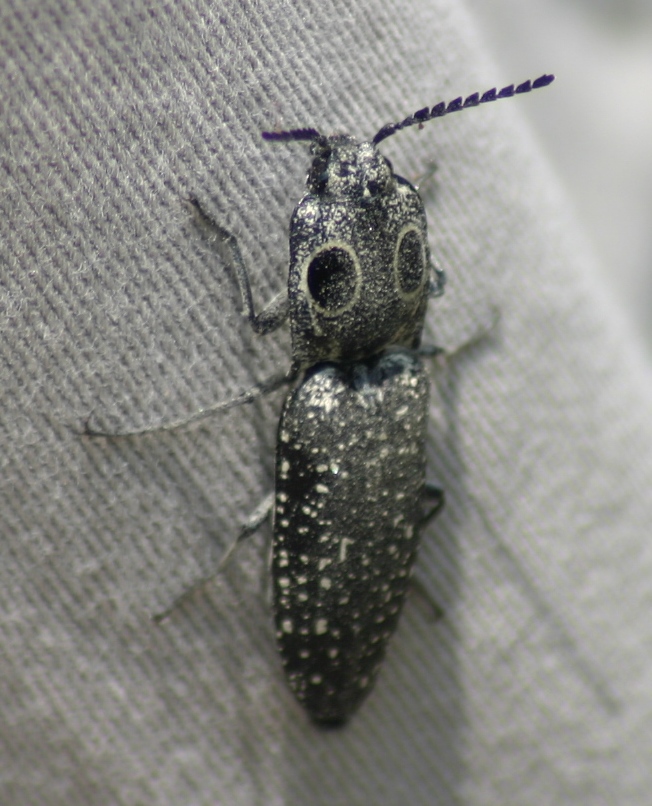 |
 |
| Eyed Click Beetle, (Alaus oculatus), Durham, 5/18/06 | Eyed Click Beetle (Alaus oculatus), Penny's Bend Nature Preserve, Durham County, NC, 5/10/11 | Eyed Click Beetle, Haw River State Park, Guilford & Rockingham Counties, NC, 5/30/08 | Eyed Click Beetle preparing for takeoff at no River State Park, Old Cole Mill Road access, Durham County, NC, 5/19/06 |
Cardiophorinae subfamily
 |
|||||
| Elaterid beetle (Horistonotus curiatus, Cardiophorinae subfamily), Durham, NC, 5/24/09. About 3 mm long. |
Dendrometrinae subfamily

|
 |
 |

|
|||||
| Click beetle (Ctenicera longicornis, Prosterninae subfamily), Standing Indian Mountain, Clay County, NC, 5/27/13. ID thanks to Blaine Mathison. | Click beetle (Ctenicera divaricata), Durham, NC, 7/8/20 | Click beetle (Ctenicera divaricata), Johnston Mill Nature Preserve, Orange County, NC, 6/16/07. ID thanks to Blaine Mathison. | Click beetle (Ctenicera divaricata), Johnston Mill Nature Preserve, Orange County, NC, 7/2/11. ID thanks to Blaine Mathison. |
Elaterinae subfamily
 |
 |
| Click beetle (Orthostethus infuscatus), Durham, NC, 70108. Photo taken at night. ID thanks to Blaine Mathison. | Click beetle (maybe Ampedus nigricollis, Elaterinae subfamily), Penny's Bend Nature Preserve, Durham County, NC, 5/6/08. |
Lissominae subfamily
 |
|||||
| Click beetle (Drapetes exstriatus), Durham, NC, 7/28/24 |
Larvae
 |
||||||
| Click beetle larva, Penny's Bend Nature Preserve, Durham County, NC, 8/31/08 |
Net-winged Beetles (family Lycidae, superfamily Elateroidea, infraorder Elateriformia, suborder Polyphaga)
 |
 |
 |
 |
 |
 |
| There are four net-winged beetles (Calopteron reticulatum) here. It's possible that it's a mating couple and two interlopers, but I wouldn't put down money on it! Durham, NC, 7/1/08 | Net-winged beetle (Calopteron reticulatum), about 1 inch long | Golden Net-winged Beetle (Dictyopterus aurora), American Tobacco Trail (Mile 5), Durham, NC, 2/26/09 | Net-winged Beetle, (most likely Eros humeralis) Durham, NC, 4/27/07. This beetle showed up about a city block from the swamp. | Net-winged Beetle (Eros humeralis), Eno River State Park, Old Cole Mill Road access, Orange County, NC, 5/10/07. ID thanks to Tim R. Moyer. | Net-winged Beetle (Plateros genus), Johnston Mill Nature Preserve, Orange County, NC, 6/9/07 |
Soldier Beetles (family Cantharidae, superfamily Elateroidea, infraorder Elateriformia, suborder Polyphaga)
Chauliognathinae subfamily
 |
 |
 |
|
| Margined Leather-wing (Chauliognathus marginatus). Wing maintenance, Durham swamp, 7/2/05. Notice the leg over the wing. | Sometime later. | Probably a Pennsylvania Leatherwing Beetle (Chauliognathus marginatus) larva, since this is by far the most common soldier beetle here. Durham, NC, 8/26/23 |
 |
 |
 |
 |
| Margined Leatherwing, Durham, 6/14/05. | Pennsylvania Leatherwing (Chauliognathus pennsylvanicus), NC Botanical Garden, Orange County, NC, 8/28/06 | Pennsylvania Leatherwing (Chauliognathus pennsylvanicus) with wing problem, Durham, NC, 5/10/19 | Leatherwing beetle with eclosing failure, Durham, NC, 9/23/12 |
 |
 |
 |
| Pennsylvania Leatherwings (Chauliognathus pennsylvanicus). Mating pair, 8/28/05, Mason Farm Biological Reserve, Orange County, NC. | ||
Cantharinae subfamily
 |
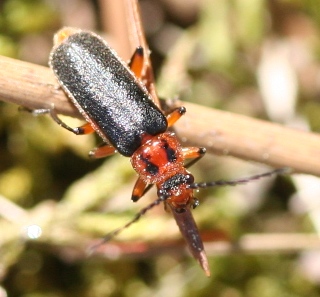 |
 |
 |
| Two-lined Leatherwing Beetles (Atalantycha bilineata), Durham, NC, 3/19/22, mating | Two-lined Leatherwing Beetle (Atalantycha bilineata), Durham, NC, 4/17/09 | Two-lined Leatherwing Beetle (Atalantycha bilineata), Durham, NC, 3/18/09 | |
Podabrocephalid Beetles (family Podabrocephalidae, superfamily Elateroidea, infraorder Elateriformia, suborder Polyphaga)
Generally, the beetle genus Podabrus is
classified in the Cantharidae family by environmental science workers, but
professional taxonomists disagree, probably because its head and thorax
structure differs greatly from that of typical Elateroideans. This
controversy is reflected on the
Tree of Life Elateroidea Page and
the
ITIS Elateriformia Page.
 |
 |
| Beetle (Podabrus rugosulus), Durham, NC, 5/13/22 | Podabrus rugosulus, Durham, NC, 5/18/09. This genus and species name is generally accepted by those working in the field. |
Carrion Beetles (family Silphidae, superfamily Staphylinoidea, infraorder Staphyliniformia, suborder Polyphaga)
American Carrion Beetle (Necrophilus americana)
 |
 |
|||||
| Carrion Beetle, Montreat, Buncombe County, NC, 5/2/12 | Acorn and Carrion Beetle, Fort Fisher State Recreation Area, New Hanover County, NC, 9/25/17 |
 |
|||||
| Carrion beetle larva, Durham, NC, 5/24/09 |
Rove Beetles (family Staphylinidae, superfamily Staphylinoidea, infraorder Staphyliniformia, suborder Polyphaga)

|
 |
 |

|
 |

|

|
|
|
| Rove beetle (Platydracus cinnamopterus complex), Durham, NC, 8/7/14 | Rove beetle (Platydracus genus), Durham, NC, 8/5/12. ID thanks to Blaine Mathison. | Rove beetle (Stenus flavicornus), Durham, NC, 1/4/21 | Rove beetle (Stenus flavicornus), Durham, NC, 4/8/14. Genus ID thanks to Craig Sondergaard. | Rove beetle (Stenus flavicornis), Durham, NC, 2/20/18 | Rove beetle (Pinophilus genus), seen on a sidewalk near a four-lane road on the Third Fork Creek Trail, Durham, NC, 6/21/12 | Rove beetle (Creophilus maxillosus), found on an outdoor trash receptacle In Winston-Salem, Forsyth County, NC, 8/23/11 | Rove beetle (Oxypoda genus, above) and Buffalo Carpet Beetle (Anthrenus scrophulariae), Nature Trail, North Carolina Botanical Garden, Orange County, NC, 4/6/23 |

|
 |
|||||
| Rove beetle, Durham, NC, 7/22/12 | Rove beetle, Jordan Lake Gameland, Chatham County, NC, 6/19/07. The foreshortened abdomen was raised in the air. |
Water Scavenger Beetles (family Hydrophilidae, superfamily Hydrophiloidea, infraorder Staphyliniformia, suborder Polyphaga)
Adults are herbivorous, the larvae carnivorous. They have to come to the surface to get air.
 |
 |
 |
| Water scavenger beetle (Hydrophilus triangularis?), in a small stream through a Jordan Lake mudflat, Chatham County, NC, 10/09/11 | Water Scavenger Beetle (Hydrophilus triangularis), Durham, 6/19/06. This beetle was underwater at the time. | Same Water Scavenger Beetle. |
Tiger Beetles (subfamily Cicindelinae, family Carabidae, suborder Adephaga)
Tiger beetles are predators. Their species distribution: USGS statistics on US tiger beetle sightings. Reference: Hoback, W. Wyatt, and John J. Riggins. 2001. Tiger beetles of the United States. Jamestown, ND: Northern Prairie Wildlife Research Center Online. http://www.npwrc.usgs.gov/resource/distr/insects/tigb/index.htm (Version 12DEC2003).
All of the tiger beetles shown below are in the tribe Cicindelini.
Eastern Pine Barrens Tiger Beetle (Cicindelidia abdominalis)
 |
|||||
| Eastern Pine Barrens Tiger Beetle (Cicindelidia abdominalis), Carolina Beach State Park, New Hanover County, NC, 8/7/18 |
Green Six-spotted Tiger Beetle (Cicindela sexguttata)
This is by far the most common tiger beetle species in my experience.
 |
 |
 |
 |
 |
 |
| Green Six-spotted Tiger Beetle, Durham, NC, 5/15/22 | Six-spotted Tiger Beetle, Durham, 3/31/07 | Six-spotted Tiger Beetle without any spots. I also saw several others just like it at I'on Swamp, Francis Marion National Forest, Charleston County, SC, 3/29/06. | Six-spotted Tiger Beetle, with 10 spots, Sandy Creek Park, Durham, NC, 3/19/10. | Six-spotted Tiger Beetle with at least eight spots. Johnston Mill Nature Preserve, 4/13/06. | Six-spotted Tiger Beetle with eight spots, Mason Farm Biological Reserve, 4/14/06 |
Festive Tiger Beetle (Cicindela scutellaris unicolor)

|
|||||
| Festive Tiger Beetle, Anastasia State Park, St. Johns County, FL 3/28/15. ID thanks to Ben Coulter. |
Bronzed Tiger Beetles (Cicindela repanda)
 |
 |
 |
 |
| Bronzed Tiger Beetle (Cicindela repanda), Mountain Lake Conservancy, Giles County, VA, 6/13/11. Near lake shore. | Bronzed Tiger Beetles (Cicindela repanda) Indian Creek trail, Chatham County, NC. These beetles resembled houseflies at a distance because of their size and movements. ID provided by Josh Rose. | Bronzed Tiger Beetle, Lake Jordan shore, Chatham County, NC, 10/16/05 | Bronzed Tiger Beetle, Occoneechee Mountain Natural Area, Orange County, NC, 3/25/07. |
Margined Tiger Beetles (Ellipsotera
marginata)
 |
||
| Mating Margined Tiger Beetles, Theodore Roosevelt Natural Area, Carteret County, NC, 7/23/08 |
Whitish Tiger Beetle (Ellipsoptera gratiosa)
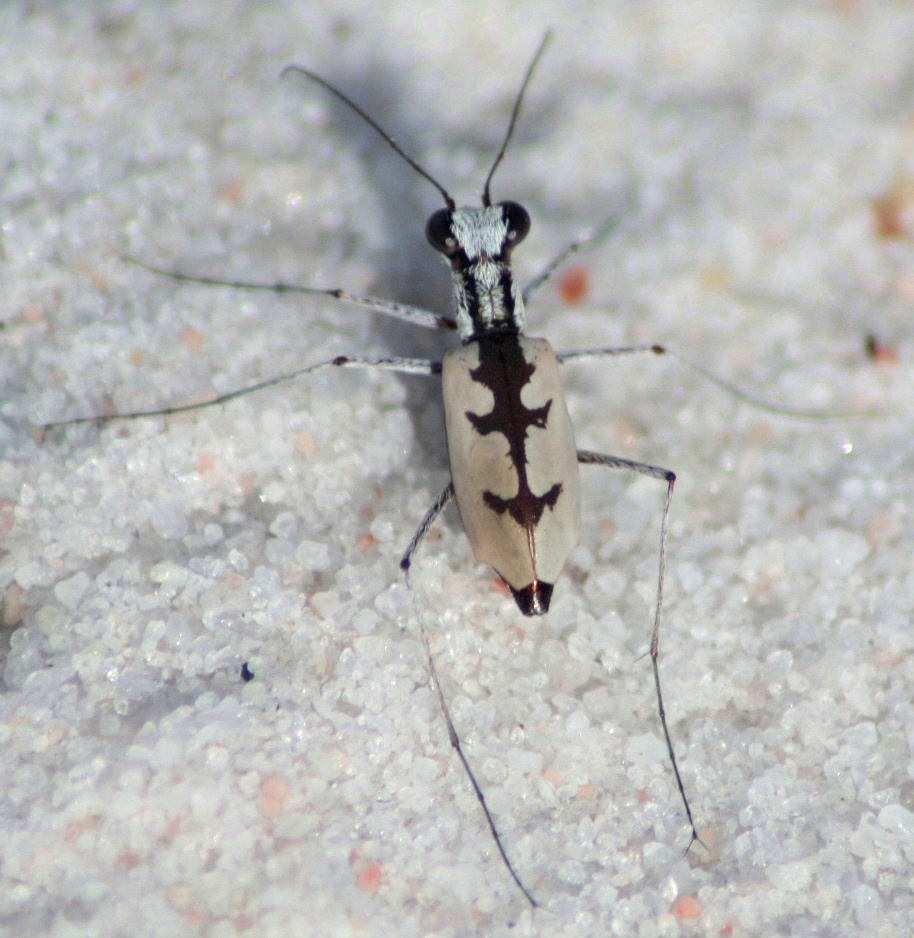 |
| Whitish tiger beetle, Carolina Beach State Park, New Hanover County, NC, 6/23/06. Although these beetles were numerous that day in the heart of CBSP, I'd never seen them there (or anywhere else) before and haven't seen any since. ID thanks to Patrick Coin of Durham, NC. |
Eastern Beach Tiger Beetle (Habroscelimorpha dorsalis)
There are two subspecies, media and dorsalis. The former is southern (south of Virginia) and common, while the other is northern and rare. The distinction between the two subspecies is described in detail in Elizabeth Ann Studer's paper: https://getd.libs.uga.edu/pdfs/studer_elizabeth_a_201608_ms.pdf. These are members of the southern subspecies, i.e., H. d. media.
 |
 |
 |
|
| Eastern Beach Tiger Beetle, Fort Macon State Park, Carteret County, NC, 7/22/08 | Eastern Beach Tiger Beetle, Ocracoke Island (north end), Hyde County, NC, 5/23/12. The genus name may have recently been changed. | Eastern Beach Tiger Beetle, Ocracoke, Hyde County, NC, 5/26/17 |
One-spotted Tiger Beetle (Apterodera unipunctata)
 |
 |
| One-spotted Tiger Beetle, Eno River State Park, Fews Ford Access, top of Cox Mountain, Orange County, NC, 5/27/06. | One-spotted Tiger Beetle, Haw River State Park, Guilford & Rockingham Counties, NC, 5/31/08. Used in Figure 3B in the following publication: Daniel P. Duran and Harlan M. Gough |
Ground Beetles (family Carabidae, suborder Adephaga)
Harpalinae subfamily
 |
 |
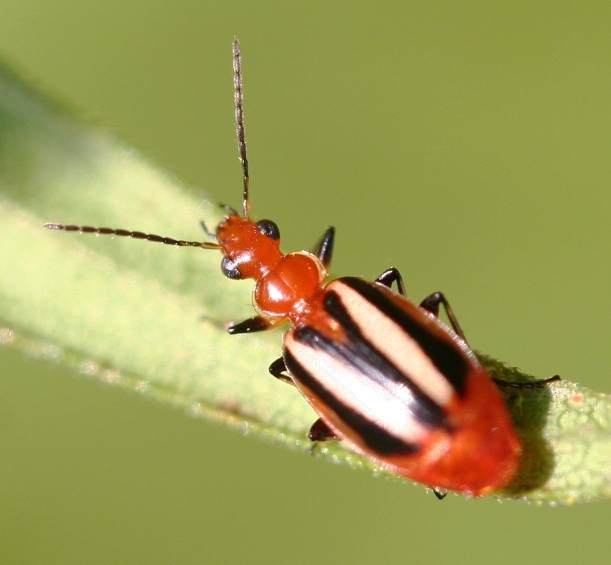 |
 |
 |
 |
| False Bombardier Beetle (Galerita genus) larva, Third Fork Trail, Durham, NC, 8/7/11 moving very fast. | False bombardier beetle, frantically running near a stream at a Jordan Lake Gameland, Chatham County, NC, 10/9/11. | Colorful foliage ground beetle (Lebia vittata, tribe Lebiini, subfamily Harpalinae). Genus ID thanks to Eric R. Eaton. Species ID thanks to Skip Blanchard. | Tiny beetle (Lebia ornata), Boone, Watauga County, NC, 8/14/19. ID thanks to Yurika Alexander. | Ground beetle (Leptotrachelus dorsalis, Ctenodactylini tribe, Harpalinae subfamily). Thanks to v. belov for genus ID and Peter Messer for species ID | Vivid Metallic Ground Beetle (Chlaenius genus) larva, Durham, NC, 7/7/12. ID thanks to Vassily Belov. |
 |
 |
 |

|
|||||
| Genus Amara, tribe Zabrini, subfamily Harpalinae, Durham, NC, 4/9/08 | Ground Beetle (Amara aulica, subfamily Harpalinae), Durham, 4/3/09. About ½ inch long. | Ground Beetle (Amara aulica), Durham, NC, 11/9/09 | Ground beetle (Amara aulica), Greenville, Pitt County, NC, 11/12/10 |
Carabinae subfamily
 |
 |
 |
 |

|
| Caterpillar Hunter (Calosoma scrutata) with prey, Durham, NC, 4/23/15 | Three Caterpillar Hunter beetles, one with prey, Durham, NC, 4/23/1 | Caterpillar Hunter, Durham, NC, 4/3/12 | Caterpillar Hunter, Durham, NC, 5/13/13 | Ground beetle (Calosoma sayi), almost an inch long, Jordan lake Gameland mudflat area, near a stream, 10/9/11. ID thanks to Jeff Winget. |
Trechinae subfamily
 |
|||||
| Ground beetle (Bembidion americanus), Jordan Lake, Chatham, NC, 10/28/17. Genus ID confirmed by Blaine Mathison. Species ID thanks to Curt Harden. |
Whirligig Beetles (family Gyrinidae, suborder Adephaga)
I get the general impression from my reading that Dineutus is the only Gyrinidae genus this big found in the continental US.
 |
 |
| Whirligig Beetle, Haw River State Park, Guilford & Rockingham Counties, NC, 5/31/08 | Whirligig Beetle, Jordan Lake, Chatham County, NC, 3/25/07. There were about a hundred such beetles in a group on the lake near the shore. |