Stink Bugs, a subset
of true bugs, are named for the odor that they produce when attacked, and
adults are easily
recognized by their general shape and by their large,
triangular "scutella." Identification of the different species
is another matter, especially for immature bugs. The nymphs of each
species go through a series of instars,
stages of development demarcated by
molting and usually characterized by striking changes in color and pattern;
wings develop through these stages and become functional in the adult. To add to the confusion, adults of the same species
sometimes come
in different colors, and not all of these differences are explained by region.
Proper identification of stink bugs is important, since this family constitutes both
some of the most beneficial and harmful insects to humans: some help farmers by
eating pests, while others are crop pests themselves. The nymphs
represent a special challenge since instars vary widely in appearance.
Even in adults, color, as the pictures below show, can vary within species.
This may vary according to nature and quality of diet. However, all use a
beak (much as spiders use their fangs) to inject digestive enzymes into their
food sources and suck out the digested material, as is the case with all True
Bugs (suborder Heteroptera).
All classifications follow standards set forth by the USDA's
Integrated Taxonomic Information System.
Many entomologists, mainly outside America, assign the predaceous stink bugs to
the Asopinae
subfamily, although the ITIS does not give it this recognition.
To see some Stink Bug predation (on Colorado Potato Beetle
larvae) photos, see Mike Tetzlaff's page.
Some stink bugs are predators (Aesopinae subfamily), while members of most
species are herbivorous
(Pentatominae subfamily). The Spined Soldier Bug is an economically
important predator; the Brown Stink Bug, the Green Stink Bug, the Southern Green
Stink Bug and the Rice Stink Bug are all economically important crop pests.
This is not entirely related to sheer numbers: in Durham, NC, the Menecles
insertus stink bug is by far the most common, but apparently gets along without
eating crops. Note the shoulder-like "pronotum" and the large triangular
scutellum (the Latin word for "shield"), which characterize adults of this family.
To see some Stink Bug predation (on Colorado Potato Beetle
larvae) photos, see Mike Tetzlaff's page.
Florida Predatory Stink Bug
5th
instarnymphs(note the separate scutella and wing pads),
Fort Fisher Recreational Area,
New Hanover County, NC, 8/27/03.
Spined Soldier Bug
(Podisus maculiventris [Say, 1832]) adult, Durham,
6/18/05. This is an especially important predator. Notice how the membranous parts of the wings
overlap at the rear, just behind the triangle-shaped "scutellum" in
the front. According to Podisus Online, this bug has proved
its effectiveness in controlling the Southern Green Stink Bug, as well
as the Colorado Potato Beetle and several Noctuidae family moth
caterpillars.
Green Stink Bug (Chinavia hilaris),
Nezarini tribe, Pentatominae subfamily
NOTE: There seems to be some controversy about whether the
Acrosternum hilare species is found in America (as well as in Europe), and
therefore whether American Green Stink Bugs should be named Chinavia hilaris.
Green Stink Bug
(Chinavia hilaris)
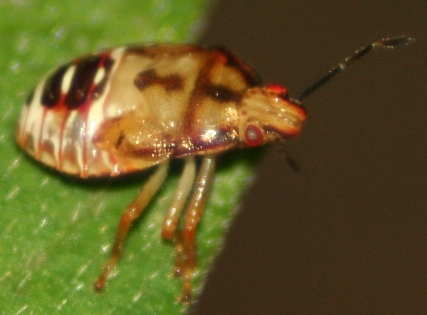
nymph, Little Scaly Mountain, Macon County, NC, 8/11/05.
Apparently an early instar, i.e., stage of development in the
immature insect, demarcated by a molt.
Green Stink Bug(Chinavia hilaris)nymph, Boone, Watauga County, 8/31/05.
ID according to
Iowa State University's Entomology Image Gallery website. This
is apparently an early instar (2nd or 3rd), but later than the one on
the left. Order a product with this picture on it at our online store.
Green Stink Bug(Chinavia hilaris)nymph, Daniel Boone Gardens,
Boone, Watauga County, NC, 8/9/06. One of the middle instars,
apparently.
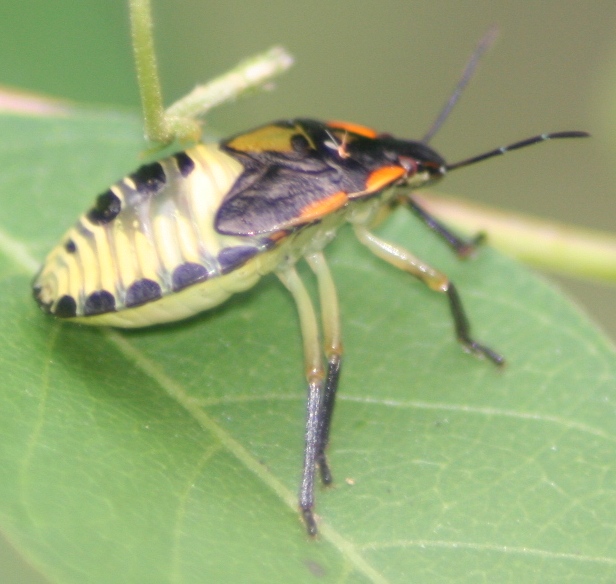
Green Stink bug
(Chinavia hilaris) nymph, appeared on San Antonio River bank. San
Antonio, Bexar County, TX, 5/28/10. A later instar.
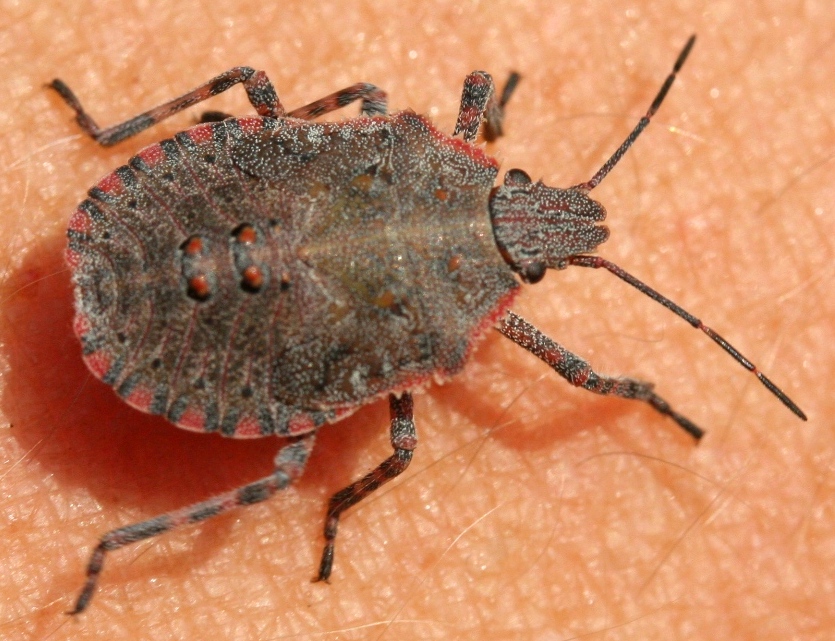
Rough
Stink Bug nymph, Boone, NC, 8/4/08. Seen in woods on Boone Green
Way Trail.
Pentatomini tribe, Pentatominae subfamily
Brown Stink Bug
(Euschistus servus [Say, 1832]),
Durham, 10/18/06. This is a notorious soybean pest. But
since soybeans aren't grown anywhere around here, seeing one around here
(in my neighborhood, in this case) is a rare treat.
Brown Stink Bug (Euschistus servus [Say, 1832]), Mason Farm
Biological Reserve, Orange County, NC, 4/25/07
Brown Stink
Bug, Durham, NC, 5/29/08
Stink bug
(Euschistus ictericus), Durham, NC, 8/21/06. Seen on cattail in my
neighborhood swamp. ID thanks to
v belov.
Stink bug (Menecles insertus [Say, 1832]), Durham,
2/9/06. Thanks to Eric Eaton for ID. These bugs are
relatively common here in the Research Triangle area. But their
relative unimportance agriculturally has made them a very obscure
species.
Stink bug (Mormidea lugens [Fabricius, 1775), Duke Forest, Korstian
Division, Orange County, NC, 6/11/06. This little critter was
about ¼ inch long. ID based on
BugGuide's Mormidea lugens page.
Rice Stink Bug (Oebalus pugnax [Fabricius, 1775]), Durham,
6/27/09.
This bug attacks rice and sorghum, but lives as a nymph on wild grasses,
including marsh vegetation, as shown here.
Rice Stink
Bug, Durham, NC, 4/25/08
Stink bug (Banasa calva [Stal, 1860]), Durham, 3/2/06,
9:28 pm. ID based on Marshall (2006), p. 112.
Stink Bug (Banasa dimiata), Eno River State
Park, Orange County, NC, 7/22/09
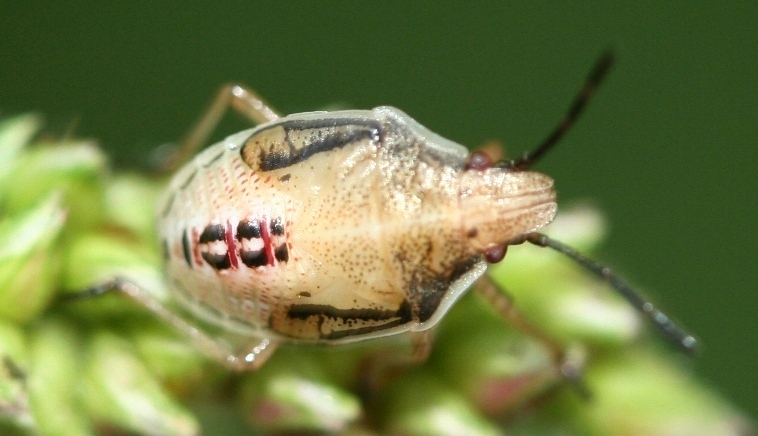
Rice Stink
Bug nymph, with wing pads, dorsal view, Durham, NC, 7/18/09. Seen
in a marsh.
Stink bug (Cosmopepla lintneriana),
McAfee's Knob, Roanoke, VA, 6/15/11
Unidentified Stink Bug Nymphs
An early-instar true bug nymph is apparently attacking a treehopper
(Telamona decorata). I am guessing that this nymph is a stink bug.
Durham, NC, 5/6/09.