|
|
Grass Skippers (Hesperiinae sub-family)
Identifying Grass Skippers isn't easy, but it can
be far more frustrating than necessary if you rely on sources that describe and
picture clearly only wing patterns and stick with small pictures
displaying only mint-condition individuals. In addition, sources
relying on photos of live skippers (or sketches copied from them) tend to
display only two views: 1) the ventral side of the hind wing, and 2) the dorsal
sides of one forewing and one hind wing. Wings are subject to more damage,
including fading, than any other part of the skipper, while antennae clubs
retain their color and differ enough across species to offer key identification
information.
On the other hand, the best identification aids
possible are useless when used to identify skippers in photos with certain
problems. The grass skipper pages on this site are intended to make the
identification process easier, starting out by showing how not to do it: see
Mystery Skippers.
Meske's Skipper (Hesperia meskei)
 |
 |
|
|
| Female Meske's
Skipper (Hesperia meskei), anomalous in not appearing on a flower.
Weymouth Woods-Sandhills Nature Preserve, Moore County, NC, 10/6/11. ID confirmed by
Harry LeGrand. |
Meske's Skipper
(dorsal view), Weymouth Woods-Sandhills Nature Preserve, Moore County,
NC, 10/5/11. |
|
|
Byssus Skipper (Problema byssus)
 |
|
|
|
|
|
| Female Byssus Skipper (Problema byssus). ID thanks to Cliff Ivy. |
|
|
|
|
|
Lace-winged Roadside-Skipper (Amblyscirtes
aesculapius)
 |
 |
| Lace-winged Roadside Skipper,
I'on Swamp, Francis Marion
National Forest, Charleston County, SC, 3/29/06. This skipper
looked very much like a Carolina Satyr or a Gemmed Satyr in flight. |
Lace-winged Roadside Skipper, Riverbend Park, Catawba County, NC,
9/24/09 |
Peck's Skipper (Polites peckius)
 |
|
|
| Peck's Skipper,
Boone, Watauga County, NC, 8/4/08 |
|
|
Tawny-edged Skipper (Polites themistocles)
 |
 |
 |
| North Carolina Botanical Garden,8/26/05 |
Same skipper |
NC Botanical Garden, 8/26/05. Photo taken by Karl Gottschalk. |
Crossline Skippers (Polites origenes)
 |
 |
| Crossline Skipper
on a Common Buttonbush,
Jordan Lake, Chatham County,
NC, 9/3/06 |
Crossline Skipper,
Ocracoke, Hyde County, NC,
5/11/06 |
Salt Marsh Skipper (Panoquina panoquin)
 |
 |
 |
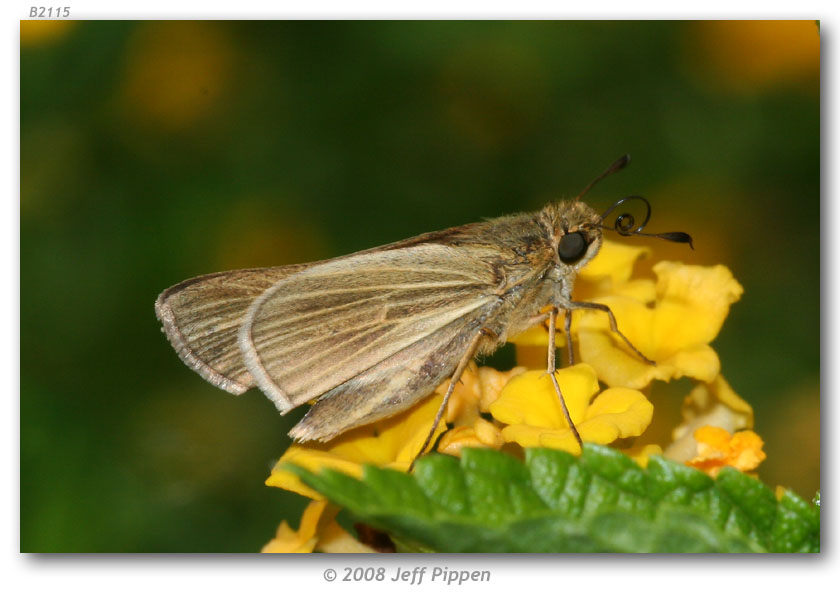
| Will Cook
and Harry LeGrand agree that this is a Salt Marsh Skipper. The
clincher was behavior: it feeds on marsh grass, close to the ground.
Compare
Jeff Pippen's 2008 Salt Marsh Skipper photo. |
Salt Marsh Skipper, Springer's Point Nature Preserve, Ocracoke, NC,
5/10/06 |
Salt Marsh Skipper,
Ocracoke, Hyde County, NC,
5/13/07 |
Ocola Skippers (Panoquina ocola)
 |
 |
 |
| Ocola Skipper(Panoquina ocola),
Durham, NC, 7/04/04, ventral view of
right hind wing and part of forewing. Ocola Skippers seem to be
relatively common in eastern North Carolina, although the butterfly
books suggest otherwise. Perhaps it's because that long forewing
makes them hard to miss. |
Ocola Skipper, Durham, 8/20/05. |
Ocola Skipper,
the local swamp in Durham, 9/3/05. |
Dion Skippers (Euphyes dion)
This skipper has a G4 Nature Conservancy Global
Rank, meaning it is "apparently secure globally."
Click on the thumbnails to see enlarged
photos.
 |
 |
| Dion Skipper, Duke Gardens, 9/17/05, on lantana. |
Dion Skipper, Durham, NC, 9/9/05 dorsal view of forewing. |
Dun Skippers (Euphyes vestris)
 |
 |
 |
|
|
| Dun Skipper, on
Common Sneezeweed,
discovered and IDed by Randy Emmitt at the Flat River Impoundment,
Durham, NC on 8/15/10 |
Dun Skipper, Duke
Gardens, Durham, NC, 8/18/07 |
Dun Skipper, Duke
Gardens, Durham, NC, 8/26/07 |
|
|
Palatka Skipper (Euphyes pilatka)
This skipper has a G3 Nature Conservancy Global
Rank, meaning it is "very rare or local throughout its range or found locally
within a restricted range" or "threatened throughout its range." It
appears to fall in the limited range category, i.e., swamps in a particular
coastal area.
 |
 |
 |
| Palatka Skipper, Alligator National Wildlife Refuge, Dare County, 5/25/04.
Thanks to Jeff Pippen for ID. |
Dare
County, NC, 10/6/05. This
skipper hid deep in tall marsh grass. Thanks to Harry LeGrand for
ID; Will Cook agrees. |
Same skipper. |
Broad-winged Skipper (Poanes viator)
 |
|
|
| Broad-winged
Skipper on marsh fleabane (camphorweed), Pluchea indica. One of
two seen together. ID thanks to Harry LeGrand. |
|
|
Delaware Skipper
 |
 |
| Delaware Skipper,
Eno River SP, Old Cole Mill Road access
(Orange County, NC), 8/17/05. |
Delaware Skipper,
same skipper. |
 |
| Delaware Skipper caterpillar,
Eno River State Park, Old Cole Mill Road
access, 6/23/05, found in the same place as the adult pictured above. |
Brazilian Skipper (Calpodes ethlius)
 |
| Carolina Beach, 9/30/04 |
Little Glassywings (Pompeius verna)
 |
 |
 |
 |
 |
 |
 |
| Little Glassywing (Pompeius verna),
Durham, 7/19/04. |
Little Glassywing,
Museum of Life & Science (outside), Durham, NC, 8/9/08 |
Little Glassywing,
Durham, 8/6/05. This skipper showed up on a butterfly bush in my
front yard. You can see a little purple on the hindwing. |
Female Little Glassywing,
Durham, 8/24/05. I tried some image processing on this one. |
Male Little Glassywing,
Penny's Bend, Durham County, NC, 8/24/05 |
Little Glassywing, NC
Botanical Garden, Orange County, NC, 8/26/05. Taken by Karl
Gottschalk. |
Little Glassywing,
Johnston Mill Nature Preserve, Orange County, NC, 6/10/07. Photo
taken by Karl D. Gottschalk. |
Eufala Skipper (Lerodea eufala)
 |
| Eno River SP, Old Cole Mill Road access, 9/16/05.
A somewhat worn individual. Thanks to Will Cook for ID. |
Swarthy Skipper (Nastra Iherminier)
 |
 |
| Penny's Bend, Durham County, NC, 9/10/05. |
Penny's Bend, Durham County, NC, 8/23/05. |
Fiery Skippers (Hylefila phyleus)
These skippers are very common in midsummer in North
Carolina but are not resident here. This species is sexually dimorphous,
meaning that the male and female are different in appearance. Wings
markings become more complex in the fall. Worn
skippers look different. Female Fiery Skippers show especially interesting
variations from the norm.
We saw a lot of fiery skippers in 2003, especially in
the North Carolina Botanical Garden, but few in 2004. However, 2005
numbers were up this August. These dramatic
differences are probably typical of species that migrate through here but don't
take up residence.
 |
 |
 |
 |
 |
 |
| Female Fiery Skipper,
unusually dark, though more wing pattern variation occurs in
the fall. Johnston Mill Nature Preserve, 9/27/07 |
Female Fiery
Skipper, Duke Gardens, 7/24/05.
|
Male and female Fiery Skippers,
Duke Gardens, Durham, NC, 10/20/07 |
Male Fiery Skipper, Durham, NC, 8/23/10 |
Male Fiery
Skipper, Durham, 10/1/05.
Lots of
autumn spots here! |
Male Fiery Skipper, Durham, 7/31/03. A classic male Fiery Skipper in a dim light, probably a
cloudy day . This is the dorsal view of the left forewing
and the right hind wing. Note the big black "stigma" next to the
abdomen and the T-shaped mark next to it. The abdomen is striped and the
division between thorax and abdomen is clearly marked. |
|
Sachems (Atolopedes campestris)
 |
 |
 |
 |
 |
|
|
|
|
|
| Male Sachem,
Durham, NC, 7/4/11 |
Male Sachem on
smartweed, Durham, NC, 8/8/11 |
Female Sachem,
Durham, NC, 8/23/10 |
Female Sachem,
Boone Greenway, Watauga County, NC, 7/6/11 |
Female Sachem,
Durham, NC, 7/4/11 |
|
|
|
|
|
Zabulon Skippers (Poanes zabulon)
 |
 |
 |
 |
|
|
|
| Female
Zabulon Skipper (dorsal view), Cox Mountain, Eno River State
Park, Fews Ford access, Orange County, NC, 5/6/07 |
Female
Zabulon Skipper (ventral view), Johnston Mill Nature Preserve,
Orange County, NC, 8/31/07 |
Male Zabulon
Skipper (dorsal view), Mason Farm Biological Reserve, Orange County, NC,
8/18/11 |
Male Zabulon
Skipper (ventral view), Mason Farm Biological Reserve, Orange County,
NC, 8/18/11 |
|
|
|
|
|
|
|
|
Southern Broken-Dashes (Wallengrenia otho)
These are found most often in Florida and
southern Texas (and Mexico), but are still more common in Durham than Northern
Broken-dashes.
 |
 |
 |
 |
 |
 |
| Female, Durham, NC, 8/1/04. Again,
note the gray-edged forewing and the tawny edged hind wing.
Unfortunately, the forewings partially block the view of the hind wings,
especially on the right. |
Southern
Broken-dash on Garlic Chive (Allium tuberosum) flowers, Durham, NC, 8/26/10 |
Southern
Broken-dash, on Swamp Milkweed at roadside in rural north Durham County,
NC,
8/15/10 |
Male Southern Broken-dash, Durham, 8/13/05. |
Male, Eno River SP, Old Cole Mill Road access (Orange
County, NC), 8/17/05. |
Male, Eno River SP, Old Cole Mill Road access (Orange
County, NC), 8/17/05.. |
Least Skippers (Ancyloxypha numitor)
Although rainy 2004 was a bad year for "true"
butterflies, it was a good year for grass skippers and a great one for Least
Skippers, the tiniest skippers I know of in North Carolina. They thrive in
humid environments and are rarely seen far from aquatic environments.
Spring of 2005 was very rainy, and it looked as though Least Skippers are hanging in there along
with skippers in tall grasses and woods butterflies. By September of 2005,
there were dozens in the swamp and territorial battles all over.
 |
 |
 |
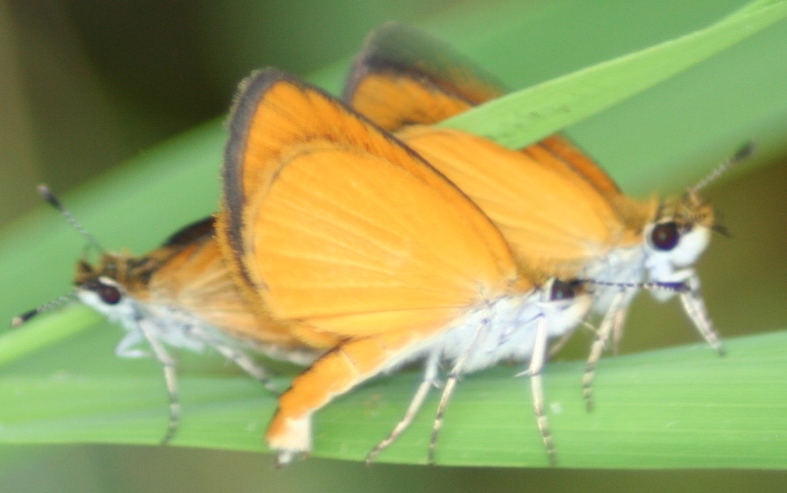
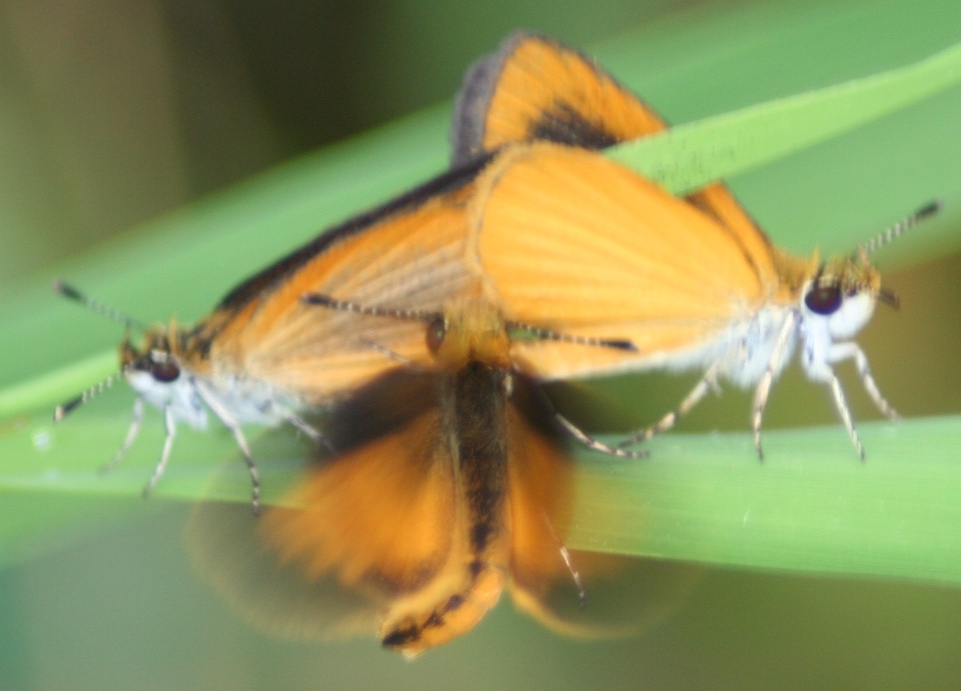
| Durham, 9/14/05. This third skipper
went to an awful lot of trouble to butt in, but mating proceeded
nonetheless. |
 |
 |
 |
|
| Durham, 6/29/05. This skipper had strayed about a
city block away from my neighborhood swamp and was visiting white clover
blossoms. |
Durham, 6/23/05. This is a foreshortened view.
Seen in tall grass at edge of swamp. |
Finally, a Least Skipper with a genuinely "weak"
flight! I caught up with it in the usual Durham swamp on 6/18/05. |
|
Clouded Skippers (Lerema accius)
 |
 |
|
| Clouded Skipper
(ventral (view), Flat River Impoundment, Durham County, NC, 8/5/11 |
Clouded Skipper
(dorsal view), Johnston Mill Nature Preserve, Orange County, NC, 8/18/11 |
|
Puerto Rico mystery skippers
 |
 |
| Mystery skipper, Isla
Verde (San Juan), Puerto Rico, 1/11/05. |
Mystery Skipper, Isla Verde, Puerto Rico,
1/09/05. This skipper seems similar to the one on the left, but
the dorsal side of the hind wings is somewhat different. |
Grass skippers are small and not very showy on the
whole. But they are a remarkable group, with more finely controlled flight
maneuvers than any other butterflies or skippers. They're real
survivors, more likely to look faded than torn-up. They migrate long
distances and survive better in cold and/or wet environments than most "true"
butterflies. They show more obvious sexual dimorphism than those do,
too.
|
Hesperiinae skippers are notoriously hard to distinguish as
a group. They're not only small, but their four wings can
seem to operate more or less independently when the skipper
is resting. Figure in orange/brown/gray iridescence and the
huge proportion of these skippers that are dark brown
with a few tiny light spots, and you have a dizzying
identification experience. Little wonder that the
term "Little Brown Job" has found its way into
the vernacular and onto over 400 webpages. (OK,
they're mostly referring to birds, but birders can't begin
to know the trouble we skipper nuts have!)
|
|
The grass skippers are especially hard to identify
because of the reason that they're also known as "folded-wing" skippers: they
typically put their forewings together and fold their hind wings over them,
greatly reducing visibility. Sometimes it gets better, such as when
they're waiting for a mate and put their hind wings down flat and open their
forewings at a 45-degree angle. If you manage to look straight down
on the one forewing, you can get a view of the dorsal sides of both wings.
If you get down a little lower, you can get three unique wing views, i.e., the
dorsal view of one hind wing, the ventral view of the forewing on the same side,
and the dorsal view of the other forewing. But it takes more than the
standard dorsal/ventral paired views necessary for the "true" butterflies to
provide enough visual information for grass skipper identification.
And when you can't get the ideal two or three views, you have to break down and
go to the dead butterfly sites.
It's probably no coincidence that grass skippers
sometimes seem to be posing for photographers, however. Like us, other skippers may have to see all these views to make a positive identification. From
all the evidence I've seen, skippers have excellent vision
and image
processing (interpretation of what they see) capabilities, and when it seems that
they're not paying attention to us they might well just be weighing the alternatives.
When they do decide that trouble is coming their way, they don't "skip" around
the way Silver-Spotted Skippers do: they move deftly and rapidly, in a way
houseflies should envy. Still in all, the effects of wear and tear
can disguise many normally identifying features of a skipper.
|
© Copyright 2005-2018 Dorothy E. Pugh